

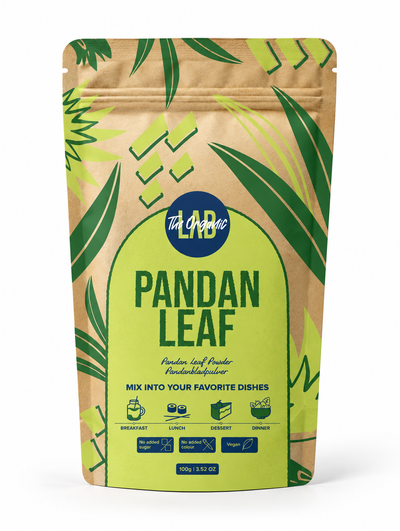
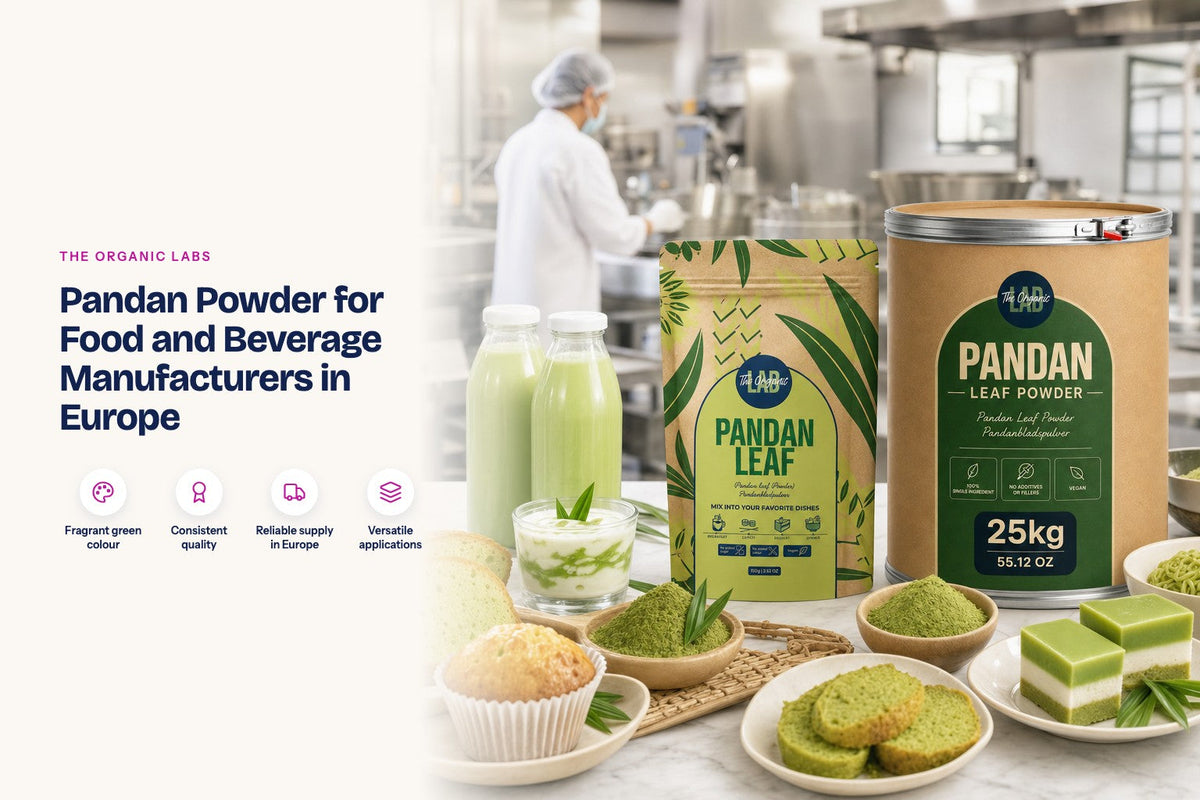
Pandan is no longer limited to Southeast Asian bakeries and restaurants in Europe. It now appears in café drinks and specialty desserts, and for manufacturers it is a natural candidate for new biscuits, chocolates, drinks, ice creams and bakery lines, especially for brands already working with coconut or matcha. Turning a café flavour into a stable, repeatable product still takes careful development work.
This guide is for product developers and technical teams working with pandan leaf powder (Pandanus amaryllifolius). It covers dosage trials, dispersion, colour and aroma under processing, batch consistency and the documents to ask for.
Where Pandan Powder Fits in a Product Range
A single ingredient brings both colour and flavour, which keeps formulations and ingredient declarations simple. Typical applications include:
- ready-to-drink and powdered beverages, including milk teas and latte mixes
- cakes, sponges, waffles, biscuits and filled bakery products
- ice cream, gelato and other frozen desserts
- fillings, spreads, creams and confectionery
- chocolate, coatings and private label products
Coconut-based products are a particularly natural fit, since pandan and coconut are paired in a great many traditional Southeast Asian desserts.
Start With Dosage Trials
There is no single correct dose. It depends on the product, the other ingredients, the processing and the intensity of colour and flavour you want. These ranges are useful starting points for bench trials:
- Drinks: 3–5 g per 300 ml serving
- Cakes and sponges: 3–6% of flour weight, with slightly more liquid, as the powder absorbs moisture
- Ice cream and gelato: 2–4% of the base
- Fillings, spreads and confectionery: 3–6% of the recipe
Run at least three levels across the range, then judge the finished product after any heat treatment, freezing or storage rather than the raw mix. More powder is not automatically better: at higher levels the grassy side of the leaf becomes more noticeable, and the extra dry matter changes texture and viscosity.
Dispersion and Texture
Pandan powder is milled leaf, so it disperses rather than dissolves. Particles that are not wetted properly form small lumps, which show up as dark green specks in a pale cream or as sediment at the bottom of a bottle. A few practices help:
- pre-blend the powder with sugar or another dry ingredient before it meets liquid
- add it under agitation, using high-shear mixing where the line allows
- give the powder time to hydrate before final checks on colour and viscosity
- for drinks, assess sedimentation over the intended shelf life and decide whether the recipe needs a stabiliser system or a shake-before-use instruction
In dry blends, remember that the powder takes up moisture from the air. Store and pack the blend so it stays free-flowing.
Colour Under Heat, Light and Acid
Pandan's green comes from chlorophyll. That gives a natural colour, but one that responds to its environment:
- Heat: baking, pasteurisation and UHT treatment shift the green towards olive. The longer and hotter the process, the larger the change.
- Acidity: low-pH products, such as fruit preparations or acidified drinks, dull the colour.
- Light and oxygen: clear packaging and display lighting fade the green over time.
Measure colour at the end of shelf life as well as on day one, and consider light-blocking packaging where colour is part of the product's appeal. If a product must stay bright green through heavy processing, raise that early in development, because a leaf powder will not behave like a synthetic colour.
Protecting the Aroma
Pandan's appeal rests largely on its aroma, and aroma compounds are delicate. Long heating and open vessels drive some of them off. Where your HACCP plan allows, add the powder later in the process, keep heating times as short as food safety permits and evaluate flavour in the finished, packed product.
Strong flavours such as dark chocolate, coffee or warm spices can mask pandan, so the dose may need to rise in those applications, or the pandan may be better placed in a separate component, such as a filling or coating.
Batch Consistency
Pandan is an agricultural ingredient, and some variation in colour and aroma between harvests is normal. Industrial users manage it with:
- an agreed specification and a retained sample from the approved batch
- incoming checks on colour, aroma and appearance against that reference
- a review of the certificate of analysis for every batch
- a supply agreement that matches forecast volume, so sources do not change mid-season
Documentation and Food Safety
Before an ingredient goes onto a production line, the technical file needs to be complete. From The Organic Labs, each batch comes with a certificate of analysis carrying the batch number you receive. We also provide a technical data sheet with the full specification, including nutritional values and analysis parameters, and an ingredient and allergen declaration for labelling. The powder is a single ingredient: 100% pandan leaf.
We work under a food safety management system certified to ISO 22000, with HACCP-based procedures implemented. For confidentiality, documents are sent by email with your quote. How the ingredient is named and described on your own pack is for your regulatory team to confirm.
Scaling Up Supply
Once a recipe is approved, supply has to keep pace with production. We supply pandan powder in 25 kg drums, from a single drum for pilot work to full pallets of 20 drums and scheduled tonnage. Our capacity is up to 60 tonnes per month; for recurring volumes we reserve production against your forecast and deliver on a call-off schedule from our stock in Sweden. Private label requests go through the same request form.
More on volumes and ordering is in our overview of bulk pandan supply in Europe, and bakery-specific advice is in our guide to baking with pandan powder.
Request Samples and Documents
Product developers can request a sample, a COA, a TDS and a quote from the bulk pandan powder page. We reply within 24 hours on working days. Home cooks who simply want to try pandan will find practical advice in our guide on how to use pandan powder.


