

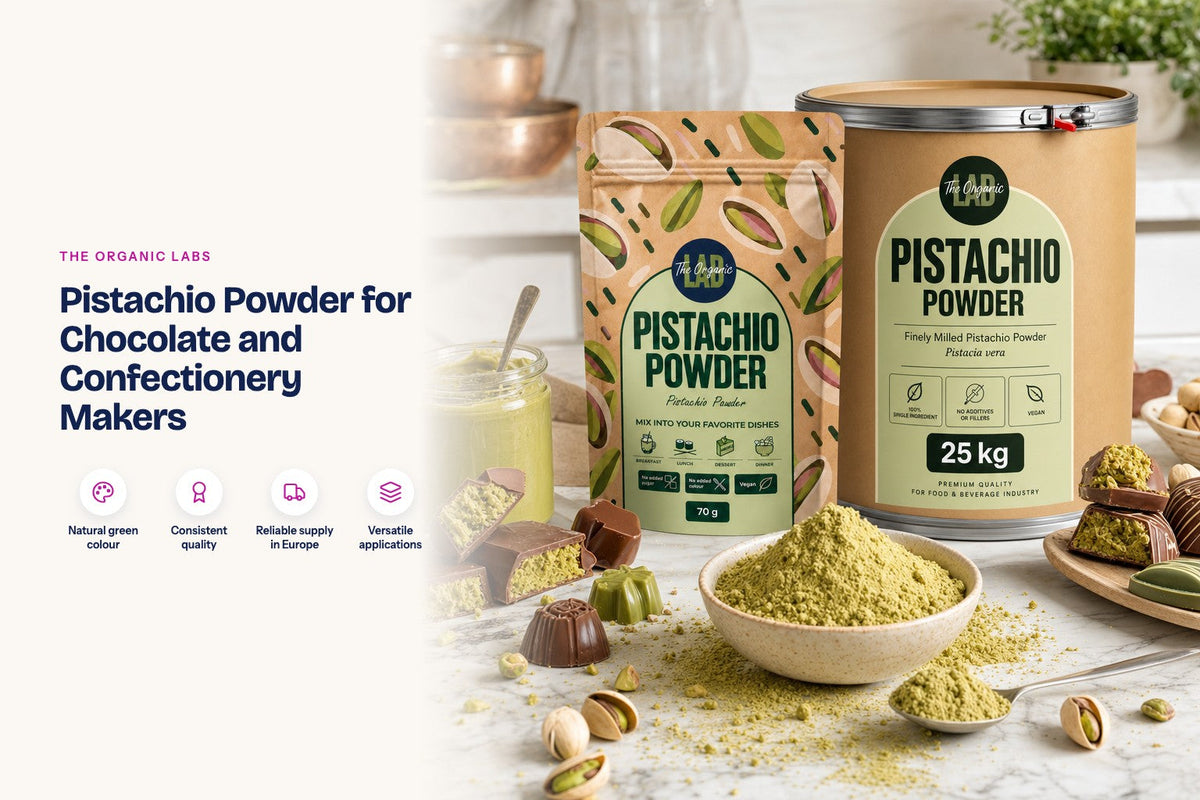
Pistachio and chocolate is one of the best-loved pairings in confectionery, from filled bars and pralines to spreads and gift boxes. For a chocolate maker, pistachio powder is a practical way in: it is a dry ingredient, so it can go straight into melted chocolate and fat-based fillings, and it brings colour and flavour in one.
This guide covers pistachio powder in filled bars, pralines and bonbons, spreads and creams, coatings and inclusions, how to handle the nut's natural oil, allergen management and testing before launch.
Why Powder Works in Chocolate
Chocolate is a suspension of fine solid particles in cocoa butter, and its great enemy is water: even a little can make melted chocolate seize. Pistachio powder brings very little moisture, so it can be stirred into melted chocolate, compound coatings and fat-based fillings without that risk. It disperses in the fat phase, much like the cocoa and milk solids already there.
Two things change when you add it. The mass becomes thicker, because you are adding solids, and the pistachio's own oil softens the set chocolate. Both are manageable, but both need to be part of the recipe from the start.
Dosage
For fillings, spreads and confectionery, the starting range is 3–6% of recipe, combined thoroughly with the other ingredients. Make trial batches across the range and judge them after setting and a few days of maturing, as flavour and texture settle. Pistachio is gentle, so the chocolate around it matters: white and milk chocolate let it come through, while dark chocolate can dominate unless the pistachio layer is substantial.
Filled Chocolate Bars
Bars with a pistachio filling usually follow a simple structure: a moulded chocolate shell, a soft pistachio filling and a chocolate back.
- Make the filling fat-based, for example pistachio powder dispersed into white chocolate with added cocoa butter or a soft filling fat, so it stays soft and contains no added water.
- Temper the filling or cool it before depositing, so it does not melt the shell.
- Let the filling crystallise fully before backing off the bar.
- For texture, fold in a crisp element such as crushed wafer or feuilletine.
Pralines and Bonbons
In moulded bonbons and enrobed pralines, pistachio powder fits two main kinds of filling:
- Fat-based fillings, such as a gianduja-style mass of chocolate, pistachio powder and cocoa butter. With almost no water, they keep well, so their shelf life is usually limited by the fat rather than by moisture.
- Ganache, made with cream, where the powder adds flavour, colour and body. Water-based ganache keeps for less time, so its recipe and water activity need the usual control.
Finely milled powder gives a slightly textured filling. For a very smooth, melting centre, some makers refine the mass further in a melanger or ball mill, or combine the powder with a smooth pistachio paste. Our comparison of pistachio powder and pistachio paste explains the difference.
Spreads and Creams
Pistachio spreads and creams are usually fat-continuous: sugar, oil or cocoa butter and milk solids or plant-based alternatives, with pistachio and often white chocolate. Pistachio powder works in these at 3–6% of the recipe. For a smooth texture, the whole mass is normally refined to reduce particle size and then mixed or conched to bring it together. A spread also needs a fat system that stays spreadable at room temperature without separating, which is worth testing over the full shelf life.
Coatings, Dustings and Inclusions
- Truffle coating: finish hand-rolled truffles in pistachio powder in place of cocoa, for a green surface that tells customers the flavour.
- Bar decoration: scatter powder over the back of a bar or tablet before it sets.
- Pistachio white chocolate: disperse the powder into white chocolate for a green-tinted coating or a distinct layer in a bar.
- Textured centres: combine the powder with crisp pieces, dried fruit or chopped nuts for a filling with bite.
Handling the Nut's Natural Oil
Pistachio's oil is what makes it so rich in a filling, and it is also the main technical challenge:
- Softening: nut oil is liquid at room temperature and softens the chocolate it mixes with. In fillings that is desirable; in shells and coatings it can reduce snap.
- Migration: over time, oil from a nut filling can move into the chocolate shell, softening it and causing fat bloom. A thicker shell, a barrier layer, a filling fat that is compatible with cocoa butter and cool storage all slow it down.
- Tempering: nut oil interferes with cocoa butter crystallisation, so chocolate with pistachio mixed into it may set softer. Check the temper after adding the powder and before moulding.
- Oxidation: nut oils can turn rancid. Store the powder sealed in a cool, dry place below 25 °C, away from direct sunlight, use it within its shelf life of 2 years from the production date, and include sensory checks in shelf-life tests of finished products.
Colour
Pistachio powder gives a natural green colour. In white chocolate it shows as a soft green; in milk chocolate it is largely hidden, and in dark chocolate it disappears. If you want customers to see the green, put it in a white chocolate layer, a filling that shows in cross-section, or a dusting on top. Natural colours can fade under strong light, so packaging that keeps light out helps keep the green in finished products.
Allergen Management
Pistachio is a tree nut: the specification states contains pistachio (tree nut). Chocolate makers often run many products on the same equipment, so bringing pistachio onto a line affects more than one recipe. Review your allergen risk assessment, plan production runs and the cleaning between them, decide whether other products made nearby need precautionary labelling, and make sure every pistachio product declares it clearly. The powder comes with an ingredient and allergen declaration for your labelling.
Testing Before Launch
- Make fillings at the low, middle and top of the 3–6% range and taste them in the finished bar or bonbon after maturing.
- Check the filling's viscosity for depositing, and how long it takes to set.
- Store test pieces at both warm and cool room temperatures and watch for softening, bloom and oil seepage over several weeks.
- Run sensory checks for stale or rancid notes across the planned shelf life.
- Test each new batch of powder in a small run, comparing colour and taste with your approved standard.
Bulk Pistachio for Chocolate Makers
The Organic Labs supplies pistachio powder in 25 kg drums to chocolate and confectionery makers across Europe, with a COA per batch and the TDS on request. Start with a sample and a quote on the Bulk Pistachio Powder 25kg page; producers with regular volumes can move to the 100 kg volume or full pallets, and private label can be requested in the same form. For broader development advice, read our guide for food manufacturers.


