

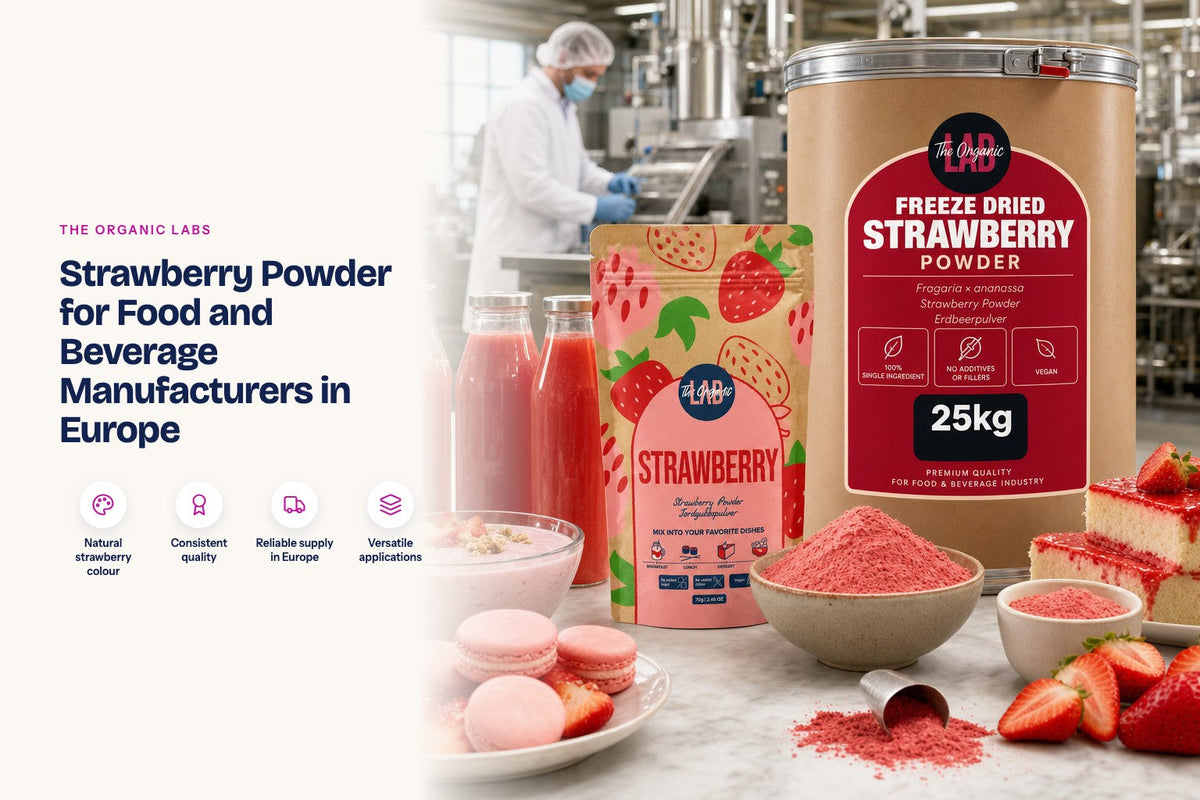
Strawberry is one of the most requested flavours in packaged food and drink, from milkshake mixes and yoghurts to bakery fillings, chocolate and ice cream. For product developers, freeze-dried strawberry powder is an attractive way to deliver it: a single fruit ingredient that is dry, easy to dose by weight and free of the water that fresh fruit or purée would bring.
A fruit powder is still a crop product, so it needs proper testing before it goes onto a production line. This guide covers how food and beverage manufacturers can work with strawberry powder, from the development brief to dosage trials, colour, moisture, batch consistency and documentation.
Where Strawberry Powder Fits in Manufactured Foods
- Dry mixes: milkshake and drink powders, baking mixes, pancake and dessert mixes
- Dairy and plant-based products: flavoured yoghurts, desserts and milk drinks
- Bakery: fillings, creams, icings and coated biscuits
- Confectionery: white chocolate, compound coatings and fat-based fillings
- Frozen desserts: ice cream, gelato and sorbet
- Beverages: ready-to-mix and café-style drinks
The powder suits dry and fat-based systems especially well, because it brings flavour and colour without adding water.
Start With a Clear Development Brief
Write the targets down before the first trial: the shade of pink you want, how strong the strawberry note should be, the process the product goes through (mixing, heating, freezing, baking), the pH of the finished product, the packaging and the intended shelf life. Agree early with your regulatory team how the ingredient will appear on the label. A clear brief makes trials faster and results easier to compare.
Dosage Trials
Kitchen recipes give a useful first range. The starting points on our product page are 1–2 tbsp per 300 ml milk drink, 2–3 tbsp per 200 g flour in cake batter, 1–2 tbsp per 200 g buttercream or filling and 3–4 tbsp per 500 ml ice cream base.
For development work, convert these to weight. Weigh the spoon amounts once on a lab scale, express them as a percentage of the recipe and build a dosage ladder around them: one trial below the range, two within it and one above. Taste and assess colour on each step in the finished product, not the mix, and record everything by weight, because spoon measures vary from person to person.
Dispersion and Mixing
Fruit powders clump when they meet liquid too quickly. In dry blends, mix the powder with sugar or other dry ingredients first so the particles are separated. In liquids, add that pre-blend under high shear or with an immersion blender and give the mix time to hydrate. In fat-based systems such as white chocolate or compound coatings, the powder must be completely dry, since any moisture it has picked up can thicken the mass. Sieve the powder before use to remove lumps formed in storage.
Colour: Heat, pH and Light
The colour of strawberry comes from anthocyanins, natural pigments also found in raspberries and blackcurrants. They look bright red under acidic conditions and duller and more purple as the pH rises towards neutral and beyond. Baking soda and long heating dull the pink, so expect a soft pink-beige in a baked crumb.
For manufacturers this means checking colour after every process step: after pasteurisation, after baking, after freezing. Light can also fade anthocyanin colours over time, so assess finished products in their real packaging, under realistic storage conditions, across their full shelf life.
Moisture and Storage
Strawberry powder takes up moisture from the air, and in a humid production area an open drum can start to cake. Keep drums closed between uses, scoop with dry tools, and store the powder dry and cool, below 25 °C. In finished dry mixes, choose packaging with a good moisture barrier and check for caking during storage trials.
Batch Consistency
Strawberries are a crop, and shade and flavour vary with variety, growing conditions and harvest. A good process allows for that. Keep a retained sample of each approved batch as a reference, compare every new batch against it for colour and taste before release, and file the certificate of analysis for each batch with your production records. If you need a tight colour tolerance, agree the acceptance criteria with your supplier at the start.
Documentation to Agree With Your Supplier
The Organic Labs is ISO 22000 certified and provides the following for bulk strawberry powder:
- A certificate of analysis (COA) per batch
- A technical data sheet (TDS) on request
- DNA testing through an external laboratory
- Ingredient: 100% strawberry (Fragaria × ananassa), freeze-dried and finely milled, with no additives or fillers
None of the 14 allergens listed in EU law are ingredients in this product, and it is vegan. For confidentiality, certificates and technical documents are sent by email with your quote.
From Pilot Batch to Production
Start with a sample to confirm colour, taste and performance in your own recipe. Move on to a pilot run on your own equipment, since mixers, ovens and freezers all affect the result, and then scale up. Bulk strawberry powder is supplied in 25 kg drums, in pallets of 500 kg (20 × 25 kg drums) and in larger quantities for industrial production, with a capacity of 60 tonnes per month.
For frozen applications, our guide to strawberry powder in ice cream and gelato covers dosing and dispersion in more depth, and our article on baking with strawberry powder looks at heat and colour in bakery products.
Sourcing Strawberry Powder for Development and Production
Request a quote, the COA and TDS, or a sample on the Bulk Freeze-Dried Strawberry Powder 25kg page. Requests receive a reply within 24 hours on working days, and approved clients can pay by invoice in 30, 60 or 90 days. If your range uses more than one colour, see all bulk powders.


