

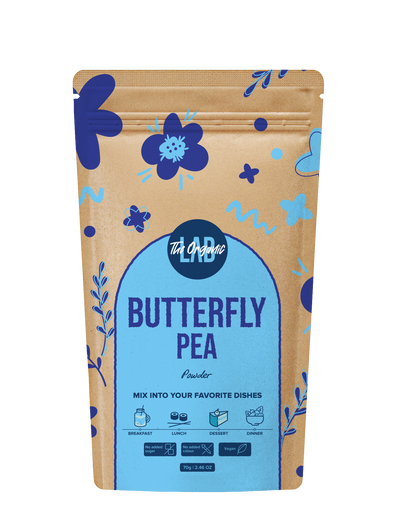
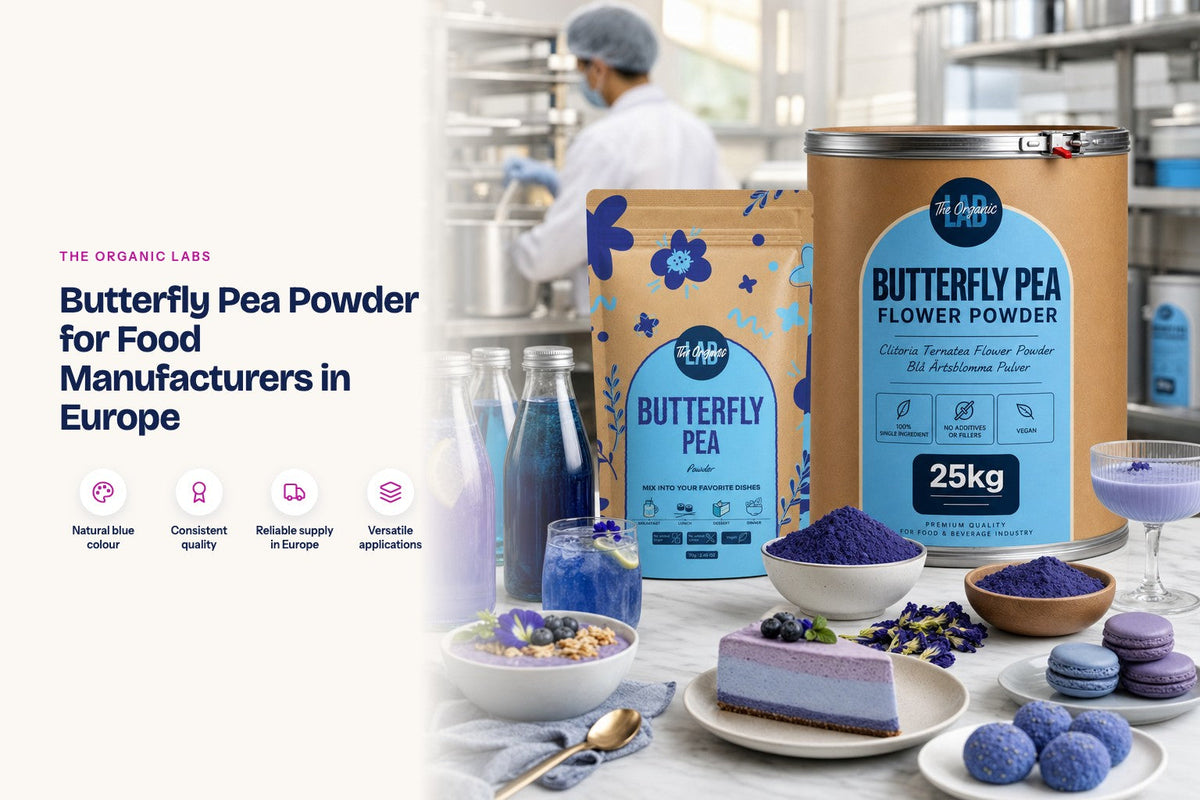
For food and beverage manufacturers, butterfly pea powder is first and foremost a colour ingredient. It gives a blue to deep indigo shade from a single declared ingredient, dried butterfly pea flower, and its very mild taste means it rarely competes with the flavour of the product. That combination makes it worth considering for drinks, bakery, dairy, frozen desserts, confectionery and dry mixes.
It is also an ingredient that reacts to its surroundings. pH, heat, light, fat and the colour of the other ingredients all influence what the consumer finally sees. This article looks at what to test during product development and what to expect from a bulk supplier.
A Colour Ingredient from One Flower
Butterfly pea powder is made from the dried, finely milled flowers of Clitoria ternatea. It is the whole flower in powder form, not an extract, and its colour comes from anthocyanins, the water-soluble pigments that also colour red cabbage and many berries.
Two consequences matter for development. First, the colour depends strongly on the chemistry of the product. Second, the powder contains plant material that does not dissolve, which affects clarity, sediment and texture in some applications.
Because the powder is used mainly for its colour, check its regulatory status, permitted uses and labelling for your product category and target markets with your regulatory adviser before launch.
Start with pH
pH is the variable that decides the shade. In a neutral product, butterfly pea gives blue. In acidic conditions the colour moves to violet and purple, and at low pH towards pink and magenta. In alkaline conditions it shifts towards teal and green.
In practice, the colour is often set by ingredients that seem unrelated to it: acidulants such as citric acid, fruit juices and purées, fermented dairy and leavening agents. Measure the pH of the base early and decide which colour you are designing for. If the recipe is adjusted later for flavour or preservation, re-check the colour at every step. Products whose pH drifts during shelf life, for example through fermentation, may drift in colour as well.
Dosage Testing
Our bulk product page gives the following starting points, to be confirmed in your own formulation:
- lattes and similar drinks: 3–5 g per 300 ml serving
- bubble tea base: 3–5 g per serving
- cakes and sponges: 3–6% of flour weight
- ice cream and gelato base: 2–4% of base
- fillings, spreads and confectionery: 3–6% of recipe
Butterfly pea is a strong colour, so for paler shades you may end up below these ranges. A dosage ladder of four or five steps, assessed in the finished product under the same standard lighting, is the quickest route to a final figure. The powder also adds dry matter and absorbs moisture, so liquids may need a small adjustment at higher dosages.
Dispersion, Clarity and Sediment
The pigment dissolves readily in water; the milled flower does not. In beverages, this gives a coloured liquid with fine suspended particles that settle over time. The right approach depends on the product:
- For milk drinks and smoothies, pre-dispersing in warm water followed by high-shear mixing or homogenisation usually gives an even result.
- For clear beverages, a process step such as infusing, settling and filtering may be needed to separate the colour from the plant material.
- For dry mixes, blending the powder with sugar or another carrier helps avoid speckling and gives a more even colour when the mix is reconstituted.
- For fat-based systems such as chocolate and compound coatings, the pigment does not dissolve in fat. Colour comes from dispersed particles, so the result can look softer and more matt than in a water-based product.
Heat Processing
Butterfly pea flowers are traditionally brewed in hot water, and the colour survives normal hot preparation. Longer or harsher processes are a different matter. Pasteurisation, UHT treatment, baking, sugar boiling and extrusion should each be tested, because prolonged heat can weaken anthocyanins and browning reactions add yellow and brown tones that turn blue towards grey or green.
Run trials on the real process, or as close to it as possible. A colour that looks right in a lab beaker can behave differently after a production-scale heat treatment.
Light and Colour Shelf Life
Like most plant colours, butterfly pea can fade during storage, particularly under light. Include colour in shelf-life studies alongside your usual parameters, and compare clear and opaque packaging if the product is sold in a transparent container. Chilled display cabinets with strong lighting deserve their own test.
The powder itself should be stored in a cool, dry place below 25 °C. Our bulk powder has a shelf life of 2 years from production date. Once a drum is opened, close it tightly after each use to keep out humidity, which causes caking.
Interactions with Other Ingredients
- Yellow ingredients such as egg yolk, butter or some cereal bases turn the blue towards teal or green.
- White bases such as milk, cream, coconut and white chocolate give pastel blues.
- Red and purple fruit hide or shift the colour.
- Acidic layers next to neutral layers create two-tone blue and purple products, which can be used on purpose.
Batch Consistency
Butterfly pea is an agricultural raw material, and natural variation between harvests and batches is normal. Manufacturers can manage it in a few ways: agree a specification with the supplier, review the certificate of analysis for each batch, keep retained samples and check each new batch against a reference standard in the actual application. Allowing a small dosage window in the recipe makes it easier to match the target colour if a batch is slightly stronger or weaker.
Supply and Documentation from The Organic Labs
The Organic Labs Sweden AB supplies 100% butterfly pea flower powder in 25 kg drums, from a single drum to full pallets of 500 kg (20 × 25 kg drums) and volumes of 1,000 kg and above. For production programmes:
- supply capacity of 60 tonnes per month, confirmed with your order
- production reserved against your forecast and delivered on a call-off schedule
- ISO 22000 certified food safety management system with HACCP-based procedures implemented
- COA per batch with your batch number, a TDS with the full specification, and an ingredient and allergen declaration
- private label supply on request
- payment by invoice in 30, 60 or 90 days for approved clients
Stock is held in Sweden and shipped to the EU and EEA, and samples are available so you can check colour, taste and performance in your own recipe before you commit.
Next Steps
Request a sample, the TDS or a quote from our Bulk Butterfly Pea Powder 25kg page, or browse all bulk powders if you are developing a range with several colours. If you are still choosing between blue colour sources, read our comparison of butterfly pea and blue spirulina, and for frozen applications see our guide to butterfly pea powder in ice cream and gelato. Home cooks who simply want to try the colour can start with our Butterfly Pea Powder 70g.


