

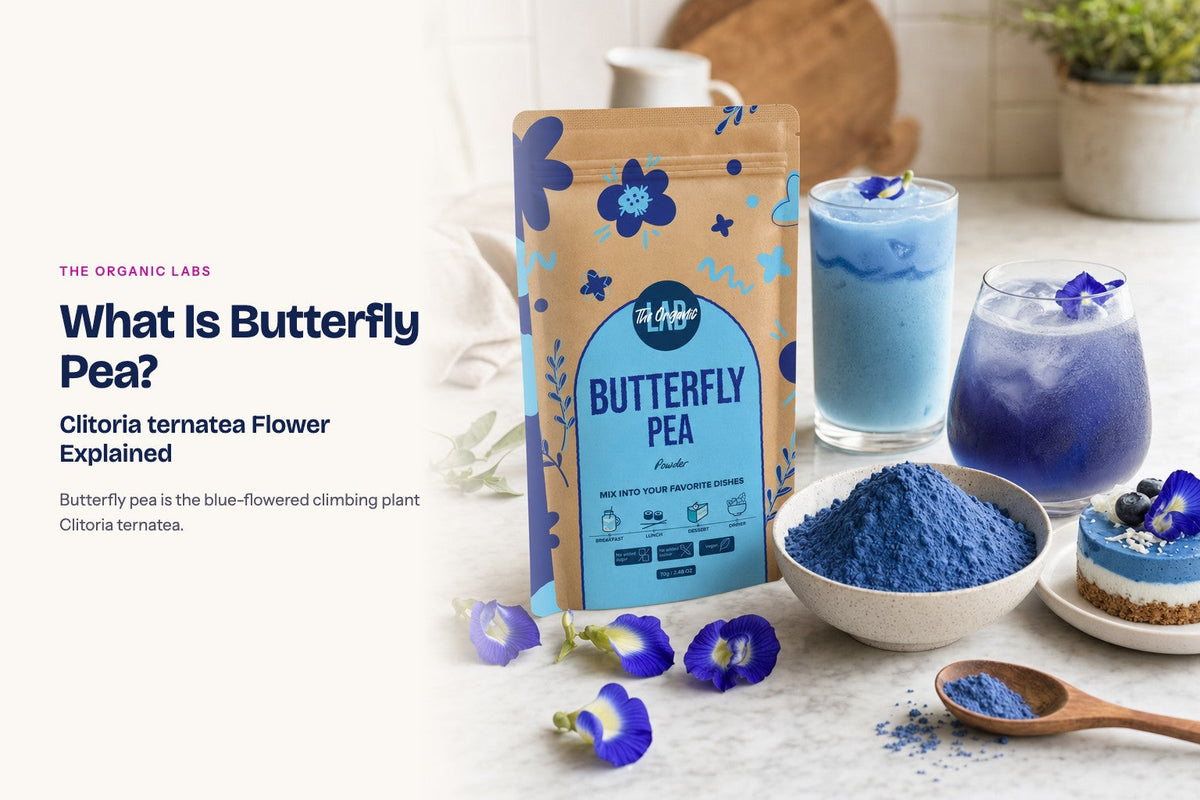
Butterfly pea is a climbing plant with deep blue flowers, known botanically as Clitoria ternatea. In Southeast Asia its petals have been used for generations to colour drinks, rice and sweets. Today the dried, finely milled flowers are sold as butterfly pea powder: an ingredient that turns food and drinks a vivid blue to deep indigo while adding very little flavour of its own.
The flower is best known for a simple piece of kitchen chemistry. Add lemon juice and the blue turns purple; add more and it moves towards pink. That colour change is a large part of the reason butterfly pea now appears on café menus, cocktail lists and pastry counters across Europe. This guide explains what the plant is, where the colour comes from and how the powder is used.
What Exactly Is Butterfly Pea?
Butterfly pea belongs to the pea family, Fabaceae, the same large plant family as beans, lentils and garden peas. It grows as a perennial vine, winding its thin stems around fences, trellises and neighbouring plants in warm climates.
The leaves are divided into small oval leaflets, and the flowers appear singly along the stems. In the best-known form, each flower has broad, intensely blue petals around a white to pale yellow centre. White and pale mauve varieties exist, as do forms with extra petals, but it is the deep blue flower that is grown for colour.
Like other legumes, the plant forms flat pods with seeds once flowering is over. For food use, though, the interest lies almost entirely in the petals.
Other Names for Butterfly Pea
The plant goes by many names. In English it is called butterfly pea, blue pea or Asian pigeonwings. In Thailand the flower is known as anchan, and in Malaysia as bunga telang. Dried whole flowers are often sold as blue tea, and the powder is sometimes marketed as blue matcha.
Those last two names deserve a comment. Butterfly pea is not tea and has no connection to the tea plant. Blue matcha is simply a trade name borrowed from the green tea powder, because both are fine, brightly coloured powders used in lattes. When buying, the botanical name is a more reliable guide than the name on the front of the pack.
Why the Botanical Name Matters
Several blue ingredients are now used in food, and in powder form they can look alike. Blue spirulina, for example, is a pigment extracted from spirulina, an entirely different organism that behaves differently in acid and heat. We compare the two in our guide to butterfly pea vs blue spirulina.
A pure butterfly pea powder should list one ingredient: butterfly pea flower, from Clitoria ternatea. Blends that combine it with sugar, milk powder, flavourings or other colours can be useful products, but they behave differently in a recipe and should be labelled as blends.
Why Is Butterfly Pea Blue?
The colour comes from anthocyanins, a group of plant pigments that also colour red cabbage, blueberries and purple yam. In butterfly pea the main pigments belong to a family of compounds known as ternatins, and they are responsible for the petals' unusually deep blue.
As with any agricultural ingredient, the exact shade varies. Growing conditions, harvest, drying and milling all play a part, so one batch of powder may lean slightly more towards royal blue and another towards indigo. The dry powder also looks darker than the colour it produces once it is dispersed in a drink or a batter.
Why Does Butterfly Pea Change Colour?
Anthocyanins respond to acidity. In plain water, which is close to neutral, butterfly pea gives a clear blue. Add an acid such as lemon or lime juice and the colour shifts to violet and purple. With more acid it moves further towards magenta and pink. In alkaline conditions, for example in a batter with a lot of baking soda, the blue can shift the other way, towards teal or green.
This is why a glass of blue butterfly pea tea turns purple when lemonade is poured in, and why the trick is so popular in cafés and bars. It also matters in recipes where nobody wants a surprise: lemon curd, yoghurt, cream cheese frosting and buttermilk batters can all pull the colour away from blue. Our guide on how to use butterfly pea powder shows how to work with this in drinks, baking and desserts.
What Does Butterfly Pea Taste Like?
Much less than its colour suggests. Butterfly pea has a very mild, earthy and slightly floral taste, and at the amounts used for colour it is close to neutral in most recipes. The flavour of a butterfly pea latte comes mainly from the milk and sweetener, and the flavour of a blue cake from its butter, sugar and vanilla. That neutrality is one of the main reasons the powder is so widely used.
From Flower to Powder
To make butterfly pea powder, the flowers are dried and then finely milled. The result is the whole flower in powder form rather than an extract, and that has practical consequences.
The blue pigment dissolves readily in water, but the plant material itself does not. When the powder is stirred into a drink, the colour spreads through the liquid while very fine particles stay in suspension and gradually settle. Whisking the powder into a little warm water before adding the rest of the liquid gives the smoothest result. For a clear drink, some kitchens prepare a concentrated infusion, leave it to settle and pour off the coloured liquid.
Compared with dried whole flowers, which are steeped and strained like tea, the powder is far easier to dose by weight and to mix into batters, doughs, creams and ice cream bases.
How Butterfly Pea Is Used in Food and Drink
In Southeast Asia, butterfly pea flowers have long coloured drinks, rice dishes such as the Malaysian nasi kerabu and glutinous rice sweets. You can read more about these traditions in our article on where butterfly pea comes from.
In European kitchens today, the powder is used in:
- hot and iced blue lattes, teas and bubble tea
- lemonades, mocktails and cocktails that change colour when citrus is added
- smoothies and smoothie bowls
- cakes, sponges, macarons, cookies, steamed buns and bread
- frostings, glazes, creams and fillings
- ice cream, gelato, panna cotta and other chilled desserts
- rice, noodles and dumpling doughs
Storing Butterfly Pea Powder
Keep the powder in a sealed container in a cool, dry place below 25 °C, away from direct light. Moisture makes fine powders clump, and strong light can dull plant colours over time. A dry spoon and a tightly closed pack go a long way towards keeping the colour consistent from the first serving to the last.
Where to Buy Butterfly Pea Powder
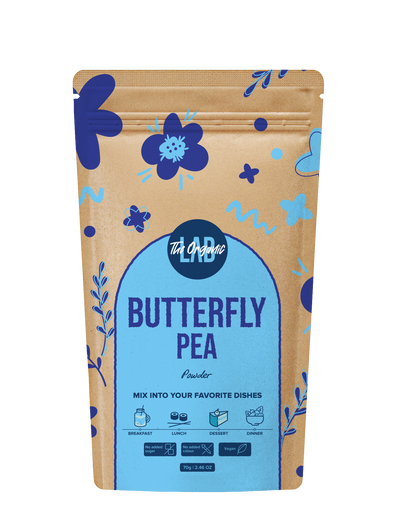
For home kitchens and first experiments, our Butterfly Pea Powder 70g is the easiest way to try the flower. Cafés, bakeries, gelato makers and food manufacturers can order Bulk Butterfly Pea Powder 25kg from The Organic Labs, with each quote prepared individually for the volume and destination.


