





Pink pitaya looks like a fruit from another planet, and its route to European café menus has been a long one. The plant began as a climbing cactus in the tropical Americas, travelled to Asia, became a major crop there and eventually reached Europe, first as an exotic fresh fruit and later as a bright magenta powder.
This article traces where pink pitaya comes from, how and where it grows today, and how it found its way into the lattes, smoothie bowls and pastries now served across Europe.
A Cactus From the Tropical Americas
Dragon fruit belongs to the cactus family, which is native to the Americas. The climbing cacti that bear these fruits, now grouped in the genus Selenicereus, grow wild from Mexico through Central America and the Caribbean into northern South America.
The red-fleshed species behind pink pitaya, Selenicereus costaricensis, is native to Central America, as its name suggests. In the wild it climbs trees and rocks, holding on with aerial roots that grow from its stems.
People in the region have eaten these fruits for a long time. In Spanish-speaking countries they are known as pitaya or pitahaya, names still used for the fruit today and the source of the name pink pitaya.
How Dragon Fruit Grows
Unlike most fruit crops, dragon fruit grows on a cactus with long, three-sided stems. It needs warmth and does not tolerate frost, but as a cactus it copes with dry spells better than many tropical crops.
The flowers are among the most striking in the plant world. Large, white and fragrant, they open at night and usually last only a single night. In the wild, night-flying moths and bats visit them. On farms, some types set fruit readily on their own, while others are pollinated by hand to secure a good crop.
In the weeks after flowering, the fruit swells and colours up. A plant can flower and fruit several times in a season, and some growers use night lighting to encourage flowering outside the natural season.
On commercial farms the stems are trained up concrete or wooden posts, often topped with a ring or frame, so the plant grows into a heavy, hanging crown that is easy to harvest by hand.
From the Americas to Asia
Over the past few centuries, dragon fruit plants were carried from the Americas to other tropical regions. In Southeast Asia they found ideal conditions: warmth, long growing seasons and farmers with long experience of tropical fruit.
Vietnam became particularly closely associated with dragon fruit, growing it on a large scale for its home market and for export. Thailand, Malaysia, Indonesia, the Philippines, southern China and Taiwan also grow the fruit, and its bright appearance made it a familiar sight in Asian markets well before it was common in Europe.
The English name "dragon fruit" is linked to its appearance: the leafy scales on the peel are often compared to the scales or flames of a dragon.
Where Pink Pitaya Is Grown Today
Today dragon fruit is grown across the tropics and subtropics. Alongside Southeast Asia, it is cultivated in Central and South America, including Mexico, Nicaragua, Ecuador and Colombia, and in warm regions such as Israel and parts of Australia.
Not every farm grows red-fleshed fruit. White-fleshed dragon fruit is the most widely planted type, and the yellow kind is a speciality in some South American countries. Red-fleshed varieties are grown wherever the market values their colour, including the processing trade that turns fruit into juices, purées and powders.
Because pink pitaya is grown in several countries and harvested in more than one season, the origin of a given lot of powder on the market can vary over time. Ask your supplier for the documentation that comes with the batch you buy.
Why Pink Pitaya Is Turned Into Powder
Fresh dragon fruit is delicate. It bruises easily, keeps only a short time once ripe, and the red-fleshed kinds are harder to find fresh in Europe than the white ones. Shipping whole fruit across the world for its colour alone makes little sense.
Drying and milling the fruit changes that. Powder is light, compact and stable when kept dry, so it travels well and keeps for a long time. It can be weighed to the gram, stored in a dry store rather than a fridge and used in any season, which is exactly what a café or bakery needs.
How Pink Pitaya Reached European Cafés
For many Europeans, the first encounter with dragon fruit was the fresh white-fleshed fruit in the exotic section of a supermarket. Pink pitaya's breakthrough came later, through food culture rather than the fruit aisle.
Smoothie bowls brought it to wide attention. Alongside the purple açaí bowl, the magenta pitaya bowl became a fixture in juice bars and brunch cafés, and photos of it spread quickly on social media. From there it moved into pink lattes, lemonades, bubble tea, doughnut glazes, macarons and gelato.
Today pink pitaya is a familiar menu name in many European cities. It appeals to cafés and bakeries that want a striking colour from fruit, and to vegan menus, because the powder is simply dragon fruit. You can read more about the fruit itself in our guide to what pink pitaya is, and about drinks in our article on pink pitaya for cafés and coffee shops.
What Origin Means for Colour and Flavour
As with any fruit, variety, climate, soil and ripeness at harvest all shape the final product, and the way the fruit is dried and milled plays a part too.
For a business, this means the shade of pink pitaya powder can vary slightly from batch to batch, even from the same supplier. Testing a sample in your own recipe, and checking each new batch against a reference, is the simplest way to keep products consistent.
Buying Pink Pitaya Powder in Europe
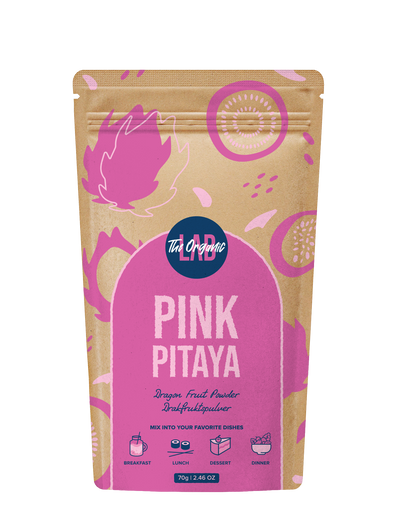
The Organic Labs Sweden AB supplies pink pitaya powder made from 100% dragon fruit, stocked and shipped from Sweden. Professional buyers can request a quote, documents or a sample for Bulk Pink Pitaya Powder 25kg, while home cooks can start with the Pink Pitaya Powder – 70g pack.


