


When a café, bakery or food brand wants blue without synthetic colours, the choice usually comes down to two ingredients: butterfly pea flower powder and blue spirulina. Both can produce a striking blue, both have a mild taste, and in the bag they can look surprisingly similar.
In use, they are very different. One turns purple when lemon is added, the other fades in acid. One copes well with a hot drink, the other is best kept away from heat. Knowing these differences saves a lot of test batches and explains most of the questions about blue products that came out purple, grey or green.
Two Very Different Ingredients
Butterfly pea powder is made from the dried, finely milled flowers of Clitoria ternatea, a climbing plant of the pea family. It is a whole ingredient: the flower in powder form. Its blue comes from anthocyanins, the same group of pigments found in red cabbage and blueberries.
Blue spirulina is not the dark green spirulina powder many people know. It is phycocyanin, the blue pigment of spirulina (Arthrospira platensis), a microscopic organism usually described as a blue-green alga. Products sold as blue spirulina are therefore a blue pigment rather than a whole plant ingredient.
That difference in origin explains almost everything that follows. Anthocyanins and phycocyanin are chemically unrelated, and each responds to acid, heat and light in its own way. For more background on the flower, see our guide What Is Butterfly Pea?
Shade: Indigo or Cyan
The two blues are not the same blue. Butterfly pea gives a deeper, cooler colour, from royal blue to dark indigo at higher amounts. In milk it softens to a periwinkle or sky blue, often with a faint violet edge.
Blue spirulina gives a brighter, lighter blue with a cyan or turquoise tone. Small amounts already produce a vivid colour, which is why it is popular for bright pastel blues in smoothie bowls and frostings.
Both are affected by the colour of the base. Yellow ingredients such as butter, egg yolk or some plant drinks pull any blue towards green, so a white base gives the cleanest result with either.
Flavour
Butterfly pea powder has a very mild, earthy and slightly floral taste. At the amounts used for colour it is generally neutral in drinks and desserts, with a light tea-like note in stronger infusions.
Blue spirulina is also very mild and largely neutral, which is one of the reasons it is used purely as a colour.
In most finished products, neither will be the dominant flavour. Milk, sugar, fruit and vanilla do that work, so flavour is rarely the deciding factor between them.
Reaction to Acid
This is the biggest practical difference. Butterfly pea behaves like a natural pH indicator. In neutral conditions it is blue; with lemon, lime or another acid it turns violet and purple; with more acid it moves towards pink and magenta. Cafés and bars use this deliberately, serving a blue drink with citrus on the side so the colour changes in the glass.
Blue spirulina does not turn purple. In acidic conditions phycocyanin tends to lose its colour and can turn cloudy or settle out, so a blue spirulina lemonade will often look duller rather than change hue.
The honest conclusion: if a product is strongly acidic and must stay blue, neither ingredient is a simple answer. Butterfly pea will become purple and blue spirulina may fade. For acidic drinks and desserts, the colour change of butterfly pea is usually best treated as a feature.
Reaction to Heat
Butterfly pea flowers are traditionally brewed in hot water, and the powder copes well with hot lattes and teas. In baking, the colour can still change: long bake times and browning dull the blue, and the pH of the batter has a strong effect. Batters with baking soda tend to push butterfly pea towards teal or green, while acidic ingredients shift it towards purple.
Blue spirulina is more sensitive to heat. Phycocyanin is a delicate pigment, and heating tends to fade it, so blue spirulina is usually added to cold or cooled preparations and kept out of the oven.
In short, the two fail in different ways in a bakery: butterfly pea is mainly a question of pH, blue spirulina mainly a question of temperature.
Light and Storage
Both pigments can fade under strong light over time, so finished drinks and desserts in clear packaging or under bright display lighting should be checked over their full shelf life. Both powders should be kept sealed, dry and away from light. Butterfly pea powder is best stored in a cool, dry place below 25 °C.
Best Uses for Each
Where butterfly pea works best
- hot and iced lattes, teas and bubble tea
- lemonades, mocktails and cocktails where the change from blue to purple is part of the drink
- steamed buns, rice and noodles
- sponges, macarons and cookies, as long as the batter pH is controlled
- purple and pink products made deliberately with lemon or other acids
- gelato, panna cotta and creams with a neutral, white base
Where blue spirulina works best
- smoothie bowls and cold smoothies made with low-acid fruit
- frostings, buttercreams and whipped toppings
- white chocolate and no-bake desserts
- ice cream bases where the colour is added after heating
- cold milk-based drinks with a neutral pH
- decorations and toppings added after baking
Can You Use Both?
Some kitchens keep both on the shelf: butterfly pea for drinks and baked goods, blue spirulina for cold frostings and toppings where a bright cyan is wanted. Combining them in one recipe is possible, but each keeps its own limits in acid and heat, so the result still needs testing in the finished product.
How to Choose
- Choose butterfly pea for deep blue to indigo shades, hot drinks, colour-changing drinks and most baked applications.
- Choose blue spirulina for bright cyan in cold, neutral, unheated products.
- For strongly acidic products, plan for purple with butterfly pea rather than expecting either ingredient to stay blue.
- With either, judge the colour in the finished product after heating, freezing or a day on display, not in the mixing bowl.
Our guide to baking with butterfly pea powder covers pH and heat in bakery products in more detail.
Buying Butterfly Pea Powder
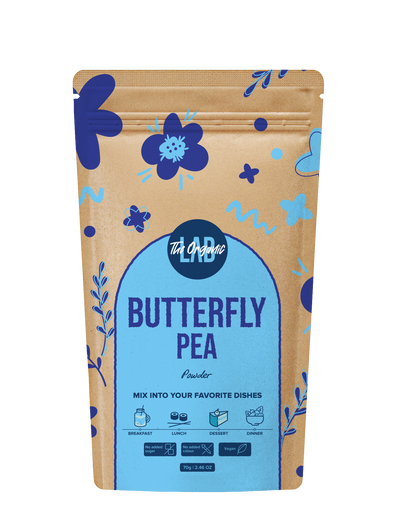
Businesses can request a quote, documents or a sample for Bulk Butterfly Pea Powder 25kg, supplied in 25 kg drums and shipped from Sweden. To test the colour at home or in a small kitchen first, start with our Butterfly Pea Powder 70g.


