


Pandan is a tropical plant grown for its long, narrow, bright green leaves. Its botanical name is Pandanus amaryllifolius, and across Southeast Asia the leaves do much the same job that vanilla does in European kitchens: they give desserts, drinks and even rice a sweet, rounded fragrance.
Outside Asia, many people first meet pandan as a green sponge cake, a green latte or a scoop of pale green ice cream. This guide explains what the plant is, where its aroma and colour come from, how it is traditionally used and how pandan leaf powder fits into a modern kitchen.
A Tropical Plant Grown for Its Leaves
Pandan belongs to the screwpine family, Pandanaceae, a group of tropical trees and shrubs. Pandanus amaryllifolius grows as a compact, leafy shrub. Its blade-like leaves spiral out from a short stem, each one glossy, flexible and smooth along the edges.
It is the leaf that cooks use. Unlike many of its relatives, this species is not grown for fruit or weaving material but almost entirely for the fragrance of its foliage. In much of Southeast Asia it is a common sight in home gardens and pots, cut as needed for the day's cooking.
What Pandan Is Called
Because it is used in so many countries, pandan goes by many names. In English it is sometimes called fragrant screwpine. In Malaysia and Indonesia it is daun pandan or pandan wangi, in Thailand bai toey, in Vietnam lá dứa and in Sri Lanka rampe.
Food writers often call it the vanilla of Southeast Asia. The two plants are not related, but the comparison describes its role well: a small amount adds a warm, sweet aroma rather than a dominant taste.
Where Does the Aroma Come From?
Whole fresh leaves have only a mild scent. Bruising, heating or drying them releases a much stronger one: sweet, warm and slightly nutty, with a green, grassy edge.
One of the main aroma compounds in pandan, 2-acetyl-1-pyrroline, is the same compound behind much of the scent of jasmine and basmati rice. That shared chemistry explains why pandan and rice are such old companions. Cooks tie a leaf into a knot and drop it into the rice pot, or simmer it in coconut milk, syrup or custard, then lift it out before serving.
The aroma is delicate. Long cooking at high heat softens it, which is one reason pandan is so often used in steamed, chilled or gently cooked dishes.
Why Is Pandan Green?
Pandan's colour comes from chlorophyll, the pigment in all green leaves. When the leaves are blended with a little water and squeezed, they give a green juice that has long been used to colour cakes, jellies and rice dumplings.
Natural pandan green is softer than many people expect. The vivid emerald of some pandan cakes and bottled pandan pastes usually comes from added colouring rather than from the leaf alone. A dessert coloured only with pandan is a gentler, fresher green, and like other chlorophyll-based colours it moves towards olive with heat, light and acidity.
How Pandan Is Used in Southeast Asian Cooking
Pandan appears in sweet and savoury dishes across the region. A few of the best known:
- Kaya, a coconut and egg jam often flavoured with pandan, spread on toast in Malaysia and Singapore
- Pandan chiffon cake, a tall, light sponge closely associated with Singapore and Malaysia
- Cendol, green rice-flour jelly served with coconut milk and palm sugar syrup
- Buko pandan, a Filipino dessert of young coconut and pandan-flavoured jelly in sweet cream
- Klepon, Indonesian glutinous rice balls filled with palm sugar and coloured with pandan
- Nasi lemak, rice cooked in coconut milk with pandan leaves
- Pandan chicken, marinated chicken wrapped in pandan leaves and fried, a Thai favourite
Leaves are also used whole: knotted into syrups, laid in steamer baskets, or folded into small cups and wrappers for sweets. Wherever pandan appears, coconut is rarely far away.
From Fresh Leaf to Pandan Powder
Fresh pandan leaves keep for only a short time, and outside the tropics they are usually found frozen, if at all. That makes them awkward for a kitchen that needs the same result every day.
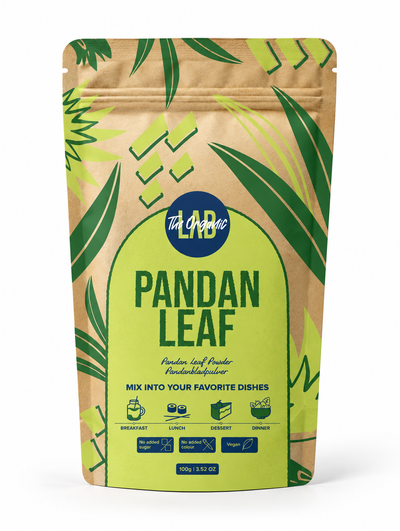
Pandan leaf powder is the practical answer. The leaves are dried and milled into a fine green powder that can be weighed, stored and added directly to batters, milk drinks and dessert bases. Because it is the whole leaf in powdered form, it carries both colour and aroma, and it disperses through a liquid rather than dissolving completely.
It is worth knowing what you are buying. A powder made only from the leaf is a different product from pandan paste, essence or flavouring, which may contain sugar, colours, flavourings or other ingredients. For recipe development, a single-ingredient leaf powder gives the most control over flavour, colour and dose.
Pandan and Its Relatives
Pandanus is a large genus, and not every pandanus is pandan. Some species are grown for their large, segmented fruit, others for tough leaves woven into mats and baskets. In South Asia, the fragrant flowers of a related species are distilled into kewra water for biryanis and sweets. Kewra has its own perfume and is not a substitute for pandan leaf.
For culinary pandan, the name to look for on a label or specification is Pandanus amaryllifolius.
Pandan in Europe Today
Pandan has long been known in European cities with Southeast Asian communities, through home cooking, restaurants and Asian grocers. In recent years it has moved onto specialty café menus and into bakery and dessert counters, often as a green alternative to matcha with a sweeter, softer flavour.
Pandan lattes, pandan and coconut cakes, green waffles and pandan ice cream are now made by cafés, bakeries and gelato makers well beyond Asia. For a closer look at the flavour, read our guide to what pandan tastes like, and for the plant's history and growing regions, see where pandan comes from.
Using Pandan in Your Kitchen or Business
Pandan leaf powder goes into lattes and iced drinks, bubble tea, sponges, cookies, doughnuts, fillings, creams, ice cream and gelato. Our guide on how to use pandan powder explains mixing methods and amounts for each, and it is the best place for home cooks to start.
Cafés, bakeries, gelato makers and food manufacturers who need regular volumes can request a quote, documents or a sample of bulk pandan powder, supplied in 25 kg drums and stocked and shipped from Sweden.


