

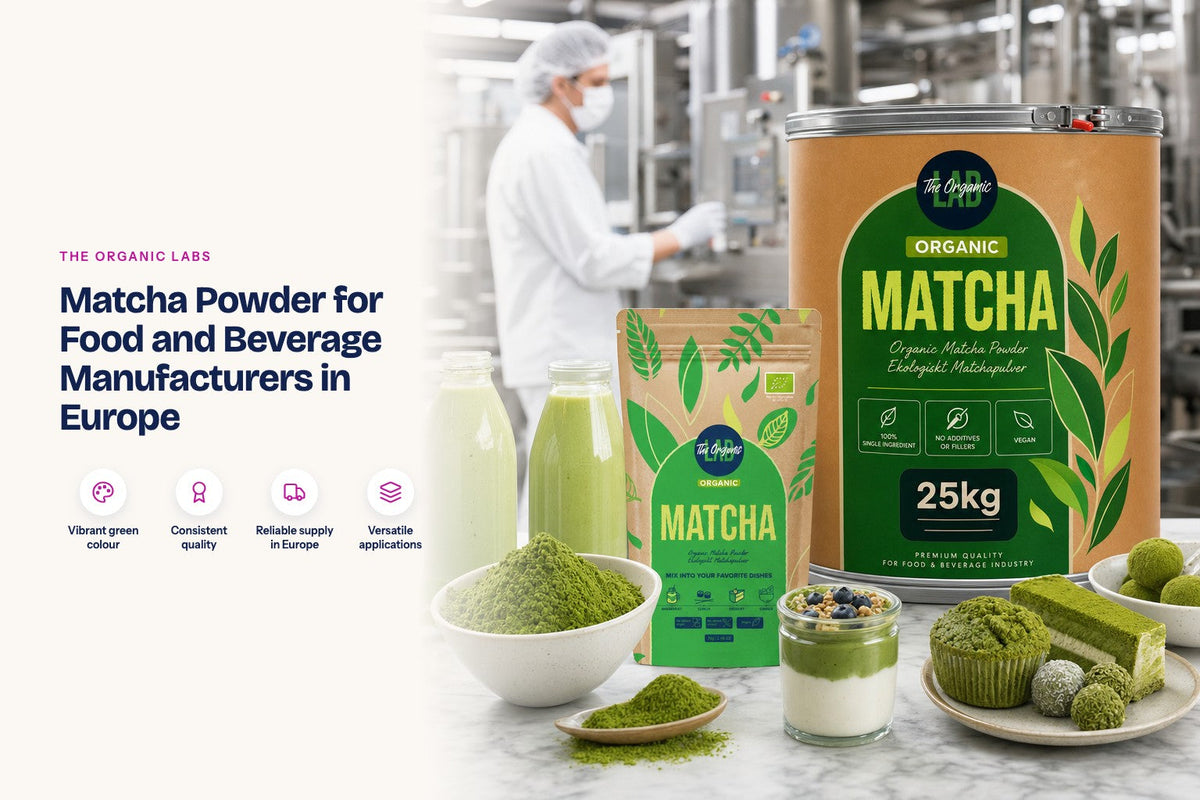
Matcha brings colour and flavour in a single ingredient, which makes it attractive to product developers working on drinks, bakery lines, frozen desserts and confectionery. It is also a natural, unstandardised powder that reacts to heat, light, moisture and acidity, so the step from kitchen recipe to production line needs careful work.
This guide is written for R&D teams, food technologists and buyers at food and beverage manufacturers. It covers the practical questions that come up when matcha moves into industrial production.
Where Manufacturers Use Matcha
- ready-to-drink teas, milk drinks and plant-based beverages
- powdered drink mixes and latte premixes
- bakery products, biscuits and filled cakes
- ice cream, gelato, frozen yoghurt and other frozen desserts
- chocolate, coatings, confectionery and spreads
- yoghurts, puddings and chilled desserts
- private label retail products
Each application asks something different of the powder. A drink needs good dispersion and a stable suspension; a biscuit needs colour that survives the oven; a chocolate needs a dry powder that does not thicken the mass too much.
Start With Dosage Trials
There is no single correct dosage. The right amount depends on the product, the other ingredients and how strong the matcha character should be. The ranges we give customers as a starting point are:
- drinks: 3–5 g per 300 ml serving
- cakes and sponges: 3–6% of flour weight
- ice cream and gelato: 2–4% of the base
- fillings, spreads and confectionery: 3–6% of the recipe
Run a short ladder of trials, for example at the bottom, middle and top of the range, and judge the finished product after heat treatment, freezing or storage. Higher doses give more colour, but also more bitterness and more dry matter, which changes texture and water absorption.
Dispersion and Suspension
Matcha does not dissolve. It is finely milled leaf, so in liquids it forms a suspension and the particles gradually settle. In practice:
- pre-blend matcha with sugar or other dry ingredients before adding liquid, which separates the particles and reduces lumps
- use high-shear mixing or homogenisation for liquid products
- for drinks, assess sedimentation over the full shelf life, not only on the day of production
- decide whether the product needs a stabiliser, or a shake-before-use instruction on the label
In fat-based systems such as chocolate and spreads, matcha behaves like other fine dry particles: it disperses into the fat phase and adds to viscosity. Check flow and mouthfeel at your intended dose before scaling up.
Colour Under Heat, Light and Acidity
Matcha's green comes from chlorophyll, which is less stable than many colouring ingredients. Developers should expect the following:
- Heat: baking, pasteurisation and UHT treatment shift the green towards olive. The longer and hotter the process, the bigger the change.
- Acidity: low-pH products such as fruit drinks and some yoghurts turn the colour duller and more yellow-olive.
- Light: products in clear packaging or under bright retail lighting fade over time.
- Oxygen and moisture: both dull the colour and flatten the aroma during storage.
Where colour matters, add matcha as late in the process as your food safety plan allows, choose packaging that limits light and oxygen, and assess colour at the end of shelf life as well as at the start.
Flavour in the Finished Product
Matcha tastes vegetal and savoury, with mild sweetness and a bitter finish. Sugar, dairy fat and vanilla soften the bitterness; acidity and salt make it more noticeable. Cold serving reduces how strongly flavour is perceived, so a frozen or chilled product often needs a higher dose than a hot one.
Matcha combines well with white chocolate, vanilla, coconut, red bean, yuzu and strawberry, which gives developers room for line extensions. Our guide to what matcha tastes like covers pairings in more depth.
Batch Consistency
No two harvests are identical, so some variation in colour and taste between batches is normal for matcha. A good quality system plans for it:
- agree a specification with your supplier before the first order
- check the COA of each incoming batch against that specification
- keep a retained sample of each approved batch as a colour and taste reference
- run a quick in-product check on each new batch before full production
Every batch from The Organic Labs comes with a certificate of analysis issued for that batch, with the batch number you receive.
Documentation for Your Technical File
We work under an ISO 22000 food safety management system with HACCP-based procedures implemented. For your supplier approval and technical file, we provide:
- a certificate of analysis (COA) per batch
- a technical data sheet (TDS) with the full product specification
- an ingredient and allergen declaration: single ingredient, declared for your labelling
The powder is listed as vegan in the specification and has a shelf life of 2 years from production date, stored in a cool, dry place below 25 °C. For confidentiality, certificates and technical documents are sent by email with your quote.
Matcha contains caffeine, so check which caffeine labelling rules apply to your finished product, particularly for drinks.
Scaling From Pilot to Production
Once a recipe works in pilot batches, supply has to keep pace. Our capacity is 60 tonnes per month. For recurring volumes we reserve production against your forecast and deliver on a call-off schedule, with finished stock held in Sweden for delivery across the EU and EEA. Bulk matcha is packed in 25 kg drums, with 20 drums to a pallet.
Private label and distribution supply can be discussed through the same request. For the commercial side, see our overview of matcha powder supply in Europe.
Request Samples and Documents
Manufacturers can request a quote, the TDS, a COA or a trial sample from the Bulk Organic Matcha Powder 25kg page, and we reply within 24 hours on working days. Other powders for production are listed under all bulk powders. For home kitchens, the Premium Organic Matcha Powder – 70g is available as a retail pack.


