


In European cafés, butterfly pea arrived as something new: the blue drink that turns purple when lemon is poured in. The plant behind it, Clitoria ternatea, is anything but new. It has been grown in tropical gardens for a very long time, and in parts of Southeast Asia its flowers have coloured drinks, rice and sweets for generations.
This article looks at where butterfly pea grows, how it is used in the kitchens it comes from, and how it found its way into lattes, lemonades and pastry counters in Europe.
A Climbing Plant of the Tropics
Butterfly pea is a perennial climbing vine in the pea family. It needs warmth, does not tolerate frost and flowers freely in hot, humid conditions, producing blooms through much of the year in the tropics.
Botanists still discuss exactly where the plant first originated. What is clear is that it now grows across the tropical world, in Asia, Africa, the Americas and northern Australia, both as a cultivated plant and growing wild along roadsides and field edges.
Its uses go beyond the kitchen. As a legume, butterfly pea works with bacteria in its roots to fix nitrogen, so it is also grown as a forage plant and a cover crop. In gardens it is planted simply for its flowers, climbing over fences and pergolas.
Where the Name Comes From
The English name describes the flower: a pea-family bloom whose broad petals are often compared to a butterfly's wings. The species name, ternatea, is usually traced to Ternate, an island in the Moluccas in present-day Indonesia.
The plant has many local names. It is called anchan in Thailand, bunga telang in Malaysia and aparajita in India, and English speakers also know it as blue pea or Asian pigeonwings. In trade, the dried flowers are often sold as blue tea.
Butterfly Pea in Thailand
Thailand is one of the countries most closely associated with butterfly pea in the kitchen. The flowers are steeped in hot water to make a blue drink, often finished with lime and sweetened with honey or sugar, and served hot or over ice. The lime does exactly what it does in a European café today: it turns the drink purple.
The same blue infusion is used to colour desserts, including sticky rice and small steamed sweets, so that blue and white sit side by side on the plate.
Blue Rice and Kuih in Malaysia and Singapore
In Malaysia, butterfly pea is best known for nasi kerabu, a blue rice dish from the state of Kelantan on the east coast. The rice takes its colour from the flowers and is served with fresh herbs, sambal and an array of side dishes.
In Peranakan, or Nyonya, kitchens in Malaysia and Singapore, the flowers colour glutinous rice for kuih, the small traditional cakes and sweets of the region. A well-known example is pulut tai tai, also called pulut tekan, a glutinous rice cake marbled with blue and served with kaya, a sweet coconut and egg jam.
These dishes show the most traditional role of butterfly pea: not as a flavour, but as a way to make food beautiful. The plant is also grown widely in India and elsewhere in South and Southeast Asia, often as an ornamental climber.
From Fresh Flowers to Dried Flowers and Powder
Fresh butterfly pea flowers are delicate and wilt quickly, so where the plant grows they are usually picked and used the same day, or dried. Drying is what allowed the flower to travel. Dried whole flowers keep well and can be steeped like tea, which made them a natural product for export.
Milling the dried flowers into a fine powder was the next step. Powder is easier to measure, mixes into batters, creams and ice cream bases, and can be dosed by weight in a café or on a production line. For businesses far from where the plant grows, it is the most practical way to use butterfly pea.
How Butterfly Pea Reached European Cafés
There was no single moment when butterfly pea arrived in Europe. Several paths led there at the same time:
- Travellers to Thailand, Malaysia and the wider region came home having tried blue drinks, blue rice and blue kuih.
- Tea shops began selling dried flowers as blue tea, with the colour change as the selling point.
- Bartenders picked up the flower for cocktails and mocktails that change colour when citrus or tonic water is added.
- Photographs and short videos of blue lattes and colour-changing lemonades spread widely on social media.
- Cafés that already served matcha and other coloured lattes added a blue latte to the same part of the menu.
The powder made the step from novelty to regular menu item possible. A café can prepare a blue latte from a measured amount of powder in moments, which is far easier than steeping flowers for every order.
Butterfly Pea in Europe Today
Because the plant needs a frost-free climate, most butterfly pea used in Europe arrives as dried flowers or powder from warmer growing regions. Today it is used by cafés and bubble tea shops, bakeries and pastry kitchens, gelato makers, cocktail bars and food manufacturers looking for a blue colour from a single plant ingredient.
Bartenders still use it for theatre, but its everyday home is now the café menu and the pastry counter, where a reliable blue matters more than the trick itself. Home cooks have taken it up too, for pancakes, birthday cakes and drinks.
If you are new to the ingredient, our guide What Is Butterfly Pea? explains the plant and its colour change, and our article on butterfly pea powder for cafés and coffee shops shows how it is used in service today.
Buying Butterfly Pea Powder
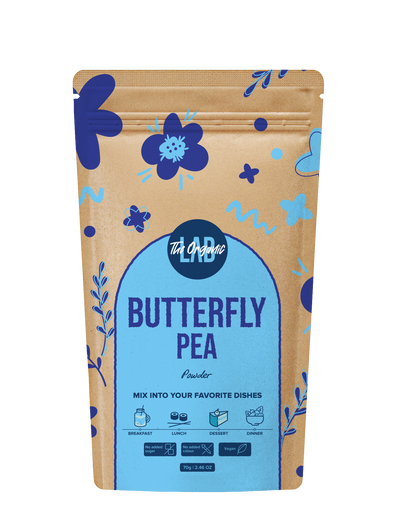
Home cooks can try the flower in their own kitchen with our Butterfly Pea Powder 70g. For cafés, bakeries and producers, The Organic Labs supplies Bulk Butterfly Pea Powder 25kg in drums, stocked and shipped from Sweden to businesses across Europe.


