

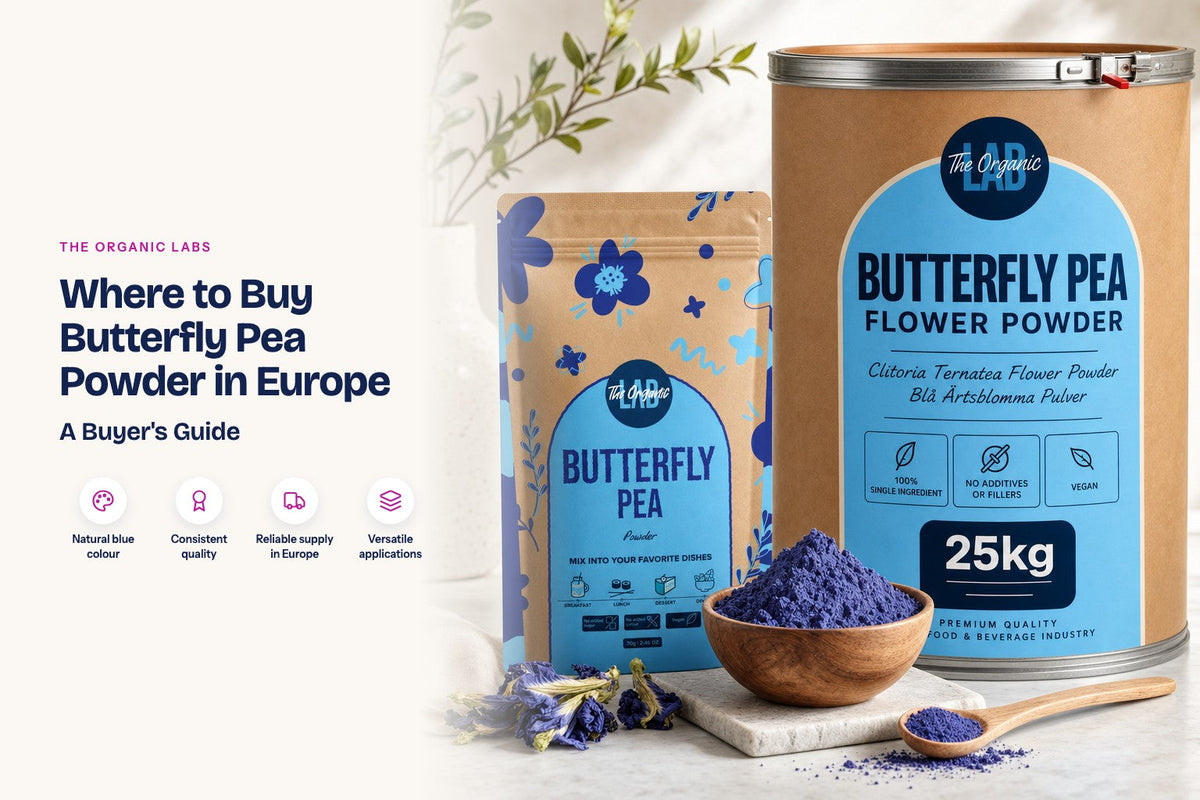
Small packets of butterfly pea powder are easy to find. Buying it for a café, bakery or production line is a different job. A business needs the same colour from one order to the next, a volume that fits its sales, documents for its food safety file and a supplier who can keep up as demand grows.
This guide covers what to check before you buy, how retail packs and bulk supply compare, and how ordering works with The Organic Labs.
Check the Botanical Name and the Ingredient List
Start with identity. Butterfly pea powder is made from the flowers of Clitoria ternatea, and a pure product should list a single ingredient: butterfly pea flower.
Read the ingredient list closely when a product has a creative name. Blue matcha, blue latte powder and similar names can refer to pure butterfly pea, to blends with sugar, milk powder or flavourings, or to other blue colour sources such as blue spirulina. Blends have their uses, but they change your recipe, your labelling and your allergen information. For professional use, a single-ingredient powder gives you full control.
Judge the Colour in Your Product, Not in the Bag
Dry butterfly pea powder looks dark in the bag. The meaningful test is how it performs in your own recipe. Make the same latte, batter or gelato base with each candidate powder, at the same dosage, and compare them side by side under the same light.
Note how much powder each one needs to reach your target shade. That figure, more than the price per kilogram, decides what an ingredient really costs you.
Taste and smell matter too. Butterfly pea should be very mild, earthy and slightly floral. A powder with a harsh or stale smell is worth questioning before it reaches a customer.
Fineness, Moisture and Packaging
A finely milled powder disperses more easily and leaves fewer specks in light-coloured products. Hard lumps or a damp feel suggest the powder has taken on moisture. Packaging should keep out humidity and light, and the pack size should suit how quickly you use it, so an opened pack is not left standing for months.
Documentation for Business Buyers
Before a new ingredient enters a professional kitchen or factory, most buyers need some or all of the following:
- a certificate of analysis (COA) for the specific batch
- a technical data sheet (TDS) with the product specification
- an ingredient and allergen declaration for labelling
- information on the supplier's food safety system
- shelf life and storage conditions
- a batch number for traceability
How quickly a supplier provides these is a useful early sign of how they will handle your account.
Supply, Volume and Terms
A supplier that is fine for one trial pack is not automatically right for regular use. Ask about pack sizes, stock, capacity for larger or recurring volumes, samples and payment terms. If your sales are seasonal, ask how the supplier plans stock across the year.
It also helps to estimate your annual use before contacting suppliers. Even a rough figure, such as under 100 kg or between 100 and 500 kg a year, lets a supplier propose a sensible pack size and delivery rhythm, and it makes quotes from different suppliers easier to compare. Our article on choosing a butterfly pea powder supplier in Europe looks at this from the professional buyer's side.
Retail Packs vs Bulk Supply
The right format depends on who is using the powder and how much of it.
- Butterfly Pea Powder 70g: for home kitchens, first tests and small recipe trials.
- Butterfly Pea Powder 500g: a larger pack for frequent home use or for developing recipes before a bulk order.
- Bulk 25 kg drums: for cafés with regular sales, bakeries, gelato makers, food manufacturers and distributors.
Retail packs are bought at the shop price. Bulk supply is quoted individually, because the price depends on volume, destination and how often you order.
How to Order from The Organic Labs
Retail packs
Our retail packs can be ordered directly in the online shop and are shipped from our facility in Sweden.
Bulk supply
For bulk orders, use the request form on our Bulk Butterfly Pea Powder 25kg page. One form covers everything: choose what you need (price quote, certificate of analysis, technical data sheet, sample or private label), then add your company details, delivery country, VAT number and the volume for this order. If you know them, add your expected annual volume and what you will use the powder for.
Volumes run from one 25 kg drum, which is the minimum order, through 50 kg, 100 kg and full pallets of 500 kg (20 × 25 kg drums) to 1,000 kg and above on a call-off schedule. We reply within 24 hours on working days with pricing, the documents you asked for, or both. Deliveries go from Sweden to the EU and EEA, and approved clients can pay by invoice in 30, 60 or 90 days.
If you prefer email, write to info@theorganiclabs.com.
Questions to Ask Before Your First Bulk Order
- Is the product 100% butterfly pea flower from Clitoria ternatea?
- Can I test a sample in my own recipe first?
- Will I receive a COA for the batch I am buying?
- What are the storage conditions and shelf life?
- What volumes can be supplied if my demand grows?
- Which payment terms are available?
For our bulk powder, the answers are on the product page: 100% butterfly pea flower, samples on request, a COA per batch, storage in a cool, dry place below 25 °C with a shelf life of 2 years from production date, capacity of 60 tonnes per month and invoice terms for approved clients.
Start with a Sample or a Small Pack
Businesses can request a quote, documents or a sample through the bulk page. Product developers working on larger programmes will find more on testing in our guide for food manufacturers using butterfly pea powder. Home cooks can simply order a 70g or 500g pack and start experimenting.


