

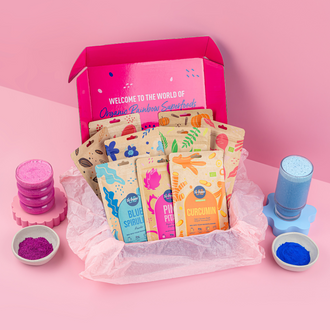

Pink is one of the most requested colours in cafés, bakeries and dessert production, and when a kitchen wants to reach it with plant ingredients, two powders come up again and again: pink pitaya and beetroot.
They can look similar in the tub and they owe their colour to the same family of pigments, yet they behave differently in a latte, a buttercream or a sponge. This comparison looks at shade, flavour, heat behaviour and the applications where each one makes sense, so you can pick the right powder for the product in front of you.
Two Very Different Foods, One Pigment Family
Pink pitaya powder is made from red-fleshed dragon fruit, the fruit of a climbing cactus (Selenicereus costaricensis). Beetroot powder is made from the root of Beta vulgaris, the same vegetable sold fresh, cooked and pickled across Europe.
A tropical cactus fruit and a temperate root vegetable seem to have little in common, but cacti and beets belong to the same broad group of flowering plants, and that group is where betalain pigments are found. Both powders get their colour from red-violet betalains called betacyanins. Betanin is the best-known example and the main pigment in beetroot; pink pitaya contains betanin along with several closely related pigments.
This shared chemistry is the key to the comparison. It explains why the two powders respond to heat, light and pH in broadly similar ways, and why the real differences come down to shade and flavour.
Shade: Bright Magenta or Deeper Red
The most visible difference is the shade.
Pink pitaya gives a vivid magenta to deep pink with a slightly purple edge. In milk or white frosting it reads as a bright fuchsia at higher amounts and a soft pastel pink at lower ones. It is the powder to reach for when the brief is simply to make something pink.
Beetroot powder leans deeper and redder: crimson to dark raspberry at higher amounts, a dusky rose at low amounts. In dairy it often looks more muted than pitaya at the same dose. That makes it useful for berry-toned, burgundy or red results, and less so for a clean, bright pink.
Both shades change with the base. Yellow ingredients such as butter, egg yolk or oat milk pull either powder towards coral or salmon, while white bases such as coconut milk or egg-white meringue show the true colour.
Flavour: Fruity or Earthy
Flavour is often what settles the choice.
Pink pitaya powder is mildly sweet with a delicate fruity taste and subtle tropical notes. At typical colouring amounts it sits quietly in the background and pairs easily with vanilla, coconut, citrus, berries and white chocolate.
Beetroot powder carries the sweet, earthy, vegetable flavour of the root. In strongly flavoured recipes such as chocolate cake or spiced bakes, a small amount can go unnoticed. In delicate products such as vanilla buttercream, milk drinks or plain gelato, the earthy note becomes noticeable as the dose rises, and a strong pink needs exactly that higher dose.
So where the pink should taste of fruit, or of nothing in particular, pink pitaya is usually the easier ingredient. Where an earthy note fits, as in many savoury products, beetroot can work well. Our guide to what pink pitaya tastes like covers its flavour pairings in more detail.
Heat Behaviour
Because both rely on betalains, both are sensitive to heat. Long baking or cooking at high temperature fades the pink and can push it towards a dull brownish tone. Neither powder behaves like a heat-stable synthetic colour.
In practice this means:
- Unheated or chilled products such as frostings, fillings, smoothies, ice cream and no-bake cheesecake hold the colour best with either powder.
- Short or gentle heating, such as warm milk drinks, macaron shells or quick glazes, is usually workable, with some softening of the shade.
- Long or hot bakes such as sponges, cookies and bread tend to lose much of their pink with either powder, especially at the crust.
Alkaline conditions speed up fading, so batters high in baking soda brown faster. Slightly acidic recipes, with ingredients such as lemon juice, buttermilk or yoghurt, tend to hold the colour better. For bakers, the practical answer is often to put the colour in the frosting, filling or glaze rather than relying on the crumb. Our guide to baking with pink pitaya powder covers this in detail.
Light and Storage
Betalain colours also fade with strong light and long exposure to air. With either powder, keep the dry product sealed, cool and dry, and keep finished products out of direct sunlight where you can. For packaged foods, light-protective packaging helps, but each formulation needs its own shelf-life testing.
Both powders are hygroscopic, meaning they pick up moisture from the air and clump if left open. Reseal containers promptly and measure with dry utensils.
Texture and Mixing
Both are dried plant powders rather than soluble dyes, so neither disappears completely into a liquid the way a liquid colour does. Pink pitaya powder is light and blends readily into liquids and batters; whisking it into a little liquid first gives the smoothest drinks. Beetroot powder handles in a similar way.
With either, sift the powder with the dry ingredients for batters, and make a smooth paste before adding it to large volumes of liquid. At high doses both add dry matter, so a heavily coloured batter or cream may need a little extra liquid.
Best Uses for Each
Choose pink pitaya powder for
- Pink lattes, iced milk drinks, smoothies, lemonades and bubble tea
- Buttercream, frostings, glazes and cream fillings
- Gelato, ice cream and sorbet
- Macarons, meringues and decorations that need a bright magenta
- Products sold on a fruit or tropical flavour story
Consider beetroot powder for
- Deep red, burgundy or berry-toned shades
- Savoury products such as fresh pasta, dips, crackers and bread, where an earthy note fits
- Strongly flavoured bakes in which its taste is masked
Some kitchens keep both: beetroot for depth in savoury items, pink pitaya wherever brightness and a clean fruity flavour matter.
Sourcing Pink Pitaya Powder
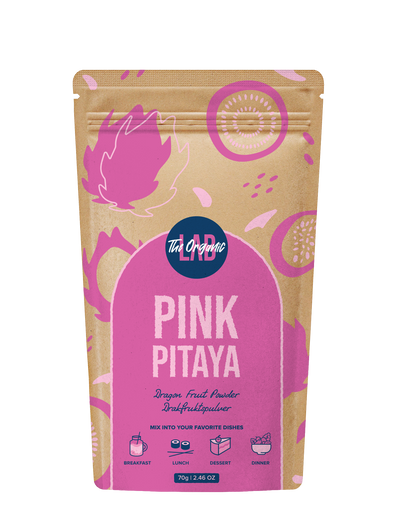
If pink pitaya is the right fit, The Organic Labs supplies Bulk Pink Pitaya Powder 25kg in drums from Sweden, with a sample and documents on request so you can test the shade in your own recipe before you commit. For home baking and drinks, the Pink Pitaya Powder – 70g pack is the simplest way to try it.


