

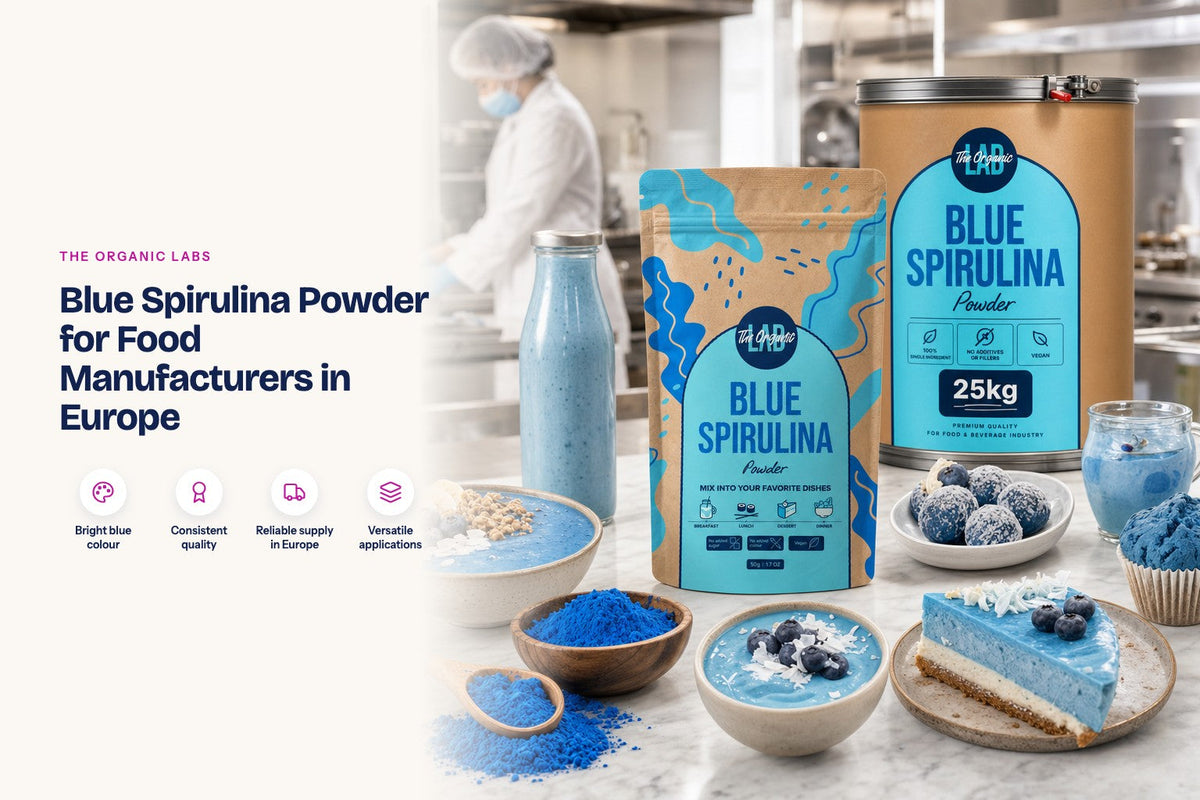
For food and beverage manufacturers, blue spirulina offers a way to give a product a bright blue using an ingredient that comes from spirulina. It is a single, water-soluble pigment, phycocyanin, extracted from Arthrospira platensis, with a brilliant blue to cyan colour and a very mild, largely neutral taste.
It is also a pigment that responds to its surroundings. Heat, pH, light and the colour of the base all shape the result. This guide covers what development teams should look at before scaling a blue product from the bench to the line.
Where blue spirulina is used in production
Typical manufactured applications include:
- dairy and plant-based drinks, milkshakes and ready-to-drink milk teas
- ice cream, gelato, frozen yoghurt and other frozen desserts
- sugar-coated and panned confectionery, and compound coatings
- dessert preparations, creams, fillings and toppings
- icings, sugar decorations and bakery finishes
- powdered drink mixes and private label products
What these have in common is that the colour is not heated hard after it goes in, and the finished product is neutral or only mildly acidic.
Start product development with the process
Before choosing a dosage, map what the product goes through after the colour is added: every heating step with its temperature and time, the pH of the finished product, the packaging and how much light reaches it, the storage temperature and the target shelf life.
That map often decides more than the recipe does. A blue that looks right in a bench sample can fade after pasteurisation, turn green in a yellow base or weaken during weeks on a lit retail shelf. Testing against the real process from the first trial saves rework later.
Dosage testing
There is no universal dosage. The right level depends on the shade you are aiming for, the colour of the base, the processing and the shelf life. A practical approach is a short ladder of three to five dosage levels, from a pale pastel to a strong blue, each judged in the finished product, after processing and after a period of storage, rather than in the liquid mix.
Start low. Blue spirulina is a concentrated colour, and overdosing pushes a product towards a dark, inky shade and can bring out a faint marine note. Record the dosage as a percentage of total recipe weight so that it scales cleanly from bench to pilot to full batch.
Dispersion and mixing
Phycocyanin dissolves in water, so the easiest route is to pre-dissolve the powder in part of the water or milk phase under gentle agitation before adding it to the main batch. Dry powder added straight to a large tank tends to form clumps that take time to break down and can leave visible specks.
For dry products such as drink mixes, blend the powder with another fine dry ingredient, such as sugar, before combining it with the rest, which spreads the colour more evenly. In fat-continuous systems, including compound coatings and chocolate, the pigment does not dissolve; it has to be finely dispersed and will usually give a softer shade than in water-based products.
Heat processing
Heat is the main limitation. Prolonged or high heat fades the blue and can shift it towards green or grey. Where the process allows, add the colour after the main heat step: after pasteurisation, during ageing of an ice cream mix or into a cooled filling. Short heat treatments are more forgiving than long ones, and cold-processed products are the most straightforward of all.
Hot-filled, retorted and long-baked products need careful trials, and in some of them a blue from spirulina will not hold up well enough. It is better to learn that at bench scale than after a production run.
pH, light and other colours
Blue spirulina keeps its colour best in neutral to mildly acidic products. In strongly acidic drinks or fruit preparations the colour can weaken, cloud or settle out during shelf life, so stability tests should run for the full intended shelf life, not just a few days.
Light also fades phycocyanin over time. Opaque or light-protective packaging is worth considering for products sold under bright retail lighting or in clear bottles.
Finally, the base colour changes the shade. A cream or yellow base pulls blue towards turquoise or green; red or pink components shift it towards purple. These effects can be used deliberately, but they should be planned rather than discovered.
Batch consistency
Blue spirulina comes from a cultivated, living raw material, so some variation in colour strength between batches is normal. Manufacturers usually manage this by keeping a retained reference sample, checking each incoming batch against it under the same light, and adjusting dosage within an agreed range when needed.
The Organic Labs issues a certificate of analysis per batch, carrying the batch number you receive, which makes it easier to trace the colour of a production run back to the powder used.
Documentation for your technical file
The Organic Labs works under an ISO 22000 food safety management system with HACCP-based procedures implemented, and is a registered food facility in the Swedish sanitary registry. For professional buyers, the following are available:
- certificate of analysis (COA) per batch
- technical data sheet (TDS) on request, with the full product specification and analysis parameters
- ingredient and allergen declaration: single ingredient, declared for your labelling
The powder is vegan, packed in 25 kg drums, to be stored in a cool, dry place below 25 °C, with a shelf life of 2 years from production date. For confidentiality, documents are sent by email with your quote.
Volumes and supply planning
Volumes run from one 25 kg drum for trials and pilot batches to full pallets of 20 drums (500 kg) and 1,000 kg and above for industrial production, with up to 60 tonnes per month available. For recurring production, The Organic Labs reserves production against your forecast and delivers on a call-off schedule from stock in Sweden. Private label supply can be discussed through the same request.
Samples and quotes
The quickest start is to request a sample and the TDS together, run your dosage ladder, then ask for a volume quote. Both can be requested from the Bulk Blue Spirulina Powder 25kg page, and we reply within 24 hours on working days. Teams working on frozen desserts may also find our guide to blue spirulina in ice cream and gelato useful, and bakery producers can read about baking with blue spirulina powder. For home cooks, the Blue Spirulina Powder – 50g is the retail pack.


