

Search for sakura in Europe and you will find plenty: sakura sweets, latte mixes, teas with dried petals and small decorative packs. Finding a sakura ingredient a business can build a menu or a product on is a different task. A café needs the same colour and flavour all season, a bakery needs a powder that survives its process, and a manufacturer needs documents before a trial can even start.
This guide explains what to check when buying sakura powder for professional use in Europe, how to estimate the quantity you need and how to order from The Organic Labs.
Start With the Application
Before comparing suppliers, write down what the sakura is for:
- the products you will make, and the dose per serving or per kilo
- how important colour is compared with flavour
- whether the product is heated, frozen, stored for a long time or displayed under bright light
- whether sakura is a spring special or a permanent item
- your expected monthly and annual volume
With these answers on paper, samples and quotes can be compared like for like.
What to Check Before Buying
Plant and ingredients
Sakura powder should be made from cherry blossom, and a supplier should be able to name the plant: Prunus serrulata, the Japanese flowering cherry. For professional recipes, a single-ingredient powder gives you the most control. Latte mixes with sugar, milk powder, flavourings or colours are different products. Powders made from salt-pickled blossoms contain salt, which changes how they behave in sweet recipes, so check the ingredient list for it.
Colour
Cherry blossom powder typically gives a soft pink rather than a saturated candy pink. If a sakura product is very bright, look at the ingredient list to see where the colour comes from. Then judge colour where it counts: in your finished product, under the light your customers will see it in.
Aroma and flavour
Mix a gram or two into warm milk and taste it. You should find a delicate floral aroma, light sweetness and a soft fruity note. A flat or dusty taste points to powder that has lost its aroma.
Documentation
Ask for a certificate of analysis for the batch you will receive, a technical data sheet and an ingredient and allergen declaration. How quickly these arrive tells you a lot about how a supplier will handle later orders.
Storage and shelf life
Check the recommended storage conditions, the shelf life and how the powder is packed. A fine floral powder needs protection from moisture, light and heat.
Supply across the season
Cherry trees flower once a year. Ask how the supplier plans stock between seasons and whether it can commit to recurring volumes. A spring menu that runs out of its key ingredient halfway through the season is an expensive lesson.
Small Packs or Bulk?
Pack size should follow usage. Small consumer packs from shops can be enough to taste sakura and try a recipe at home. Once a business serves sakura every day or runs it in production, small packs mean frequent reorders, more packaging and a product that may change from one purchase to the next.
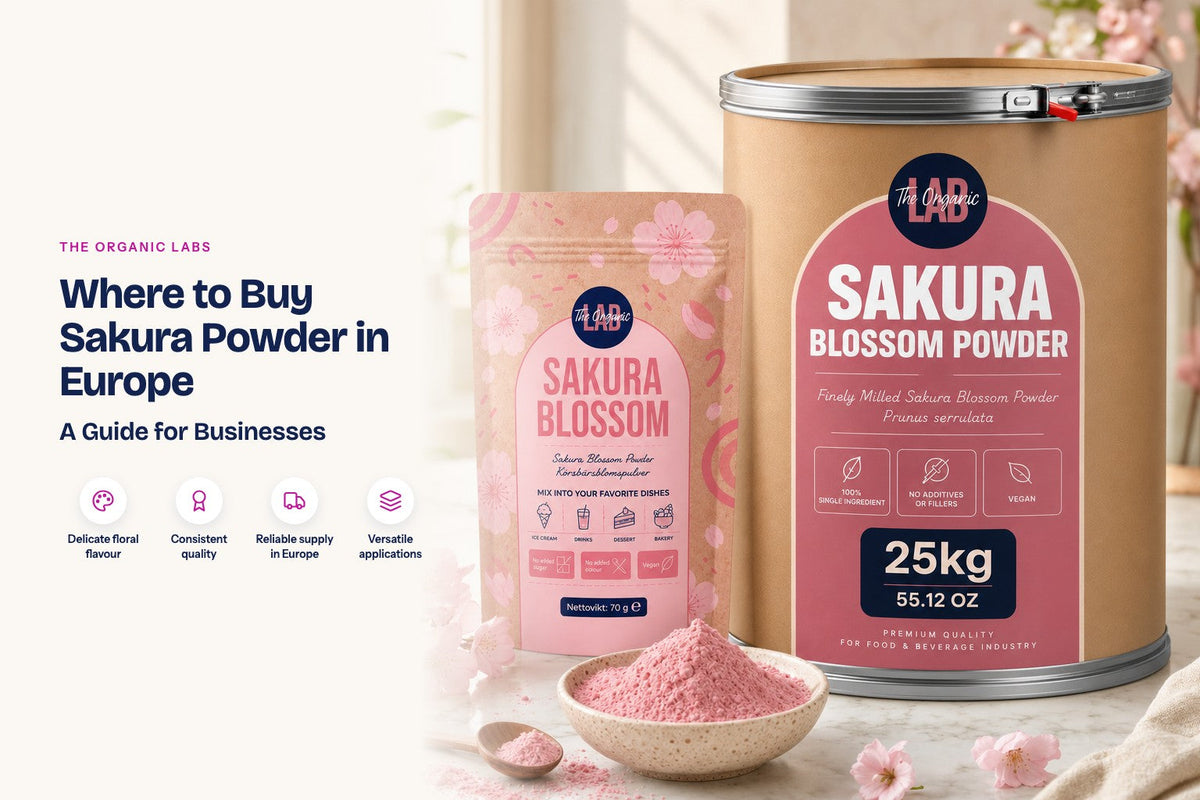
Our sakura is supplied in bulk, in 25 kg drums. The minimum order is one drum, and businesses that want to test the powder first can ask for a sample with their quote request.
Working Out How Much You Need
A quick calculation shows which volume step suits you:
- A café selling 40 sakura lattes a day at 4 g each uses 160 g a day, or roughly 5 kg a month. One 25 kg drum covers about five months.
- A bakery making 30 sponges a week from 500 g of flour each, with sakura at 4% of flour weight, uses 600 g a week.
- A gelateria making 20 kg of sakura base a week at 3% uses 600 g a week.
Compare these figures with the shelf life of 2 years from the production date, and plan storage so opened drums stay closed, cool and dry between uses.
Common Buying Mistakes
- Choosing on the colour of the dry powder alone, without testing it in the finished product.
- Buying a sweetened mix by mistake and then struggling to control sugar levels in the recipe.
- Expecting cherry blossom to give a vivid pink. If strong colour is the goal, read our comparison of sakura and pink pitaya powder.
- Ordering for spring too late, when demand is at its highest.
- Approving a sample and not checking that later deliveries match it.
How to Order Sakura From The Organic Labs
The Organic Labs Sweden AB supplies sakura powder in bulk to cafés, bakeries, gelato makers, food manufacturers, distributors and private label businesses across Europe, from one 25 kg drum to pallets of 20 drums and scheduled volumes of 1,000 kg and more.
- Send a request with quantity, delivery country, application and expected annual volume.
- Receive a quote and the documents you asked for by email. We reply within 24 hours on working days.
- Test a sample in your own recipe.
- Take delivery from our warehouse in Sweden.
Prices are quoted per volume, destination and delivery rhythm. Approved clients can pay by invoice in 30, 60 or 90 days. A COA is issued per batch, and we work under an ISO 22000 food safety management system with HACCP-based procedures implemented.
Delivery Across Europe
Our sakura is stocked and shipped from Sweden, with deliveries to the EU and EEA. Delivery cost, terms and lead time are confirmed in your quote. For recurring volumes, we can supply up to 60 tonnes per month on a call-off schedule. More detail is in our overview of bulk sakura supply in Europe.
Ready to Order
Businesses can request a quote, a COA, a TDS or a sample from the Bulk Sakura Powder 25kg page. Home cooks looking for ideas can start with our guide on how to use sakura powder.


