

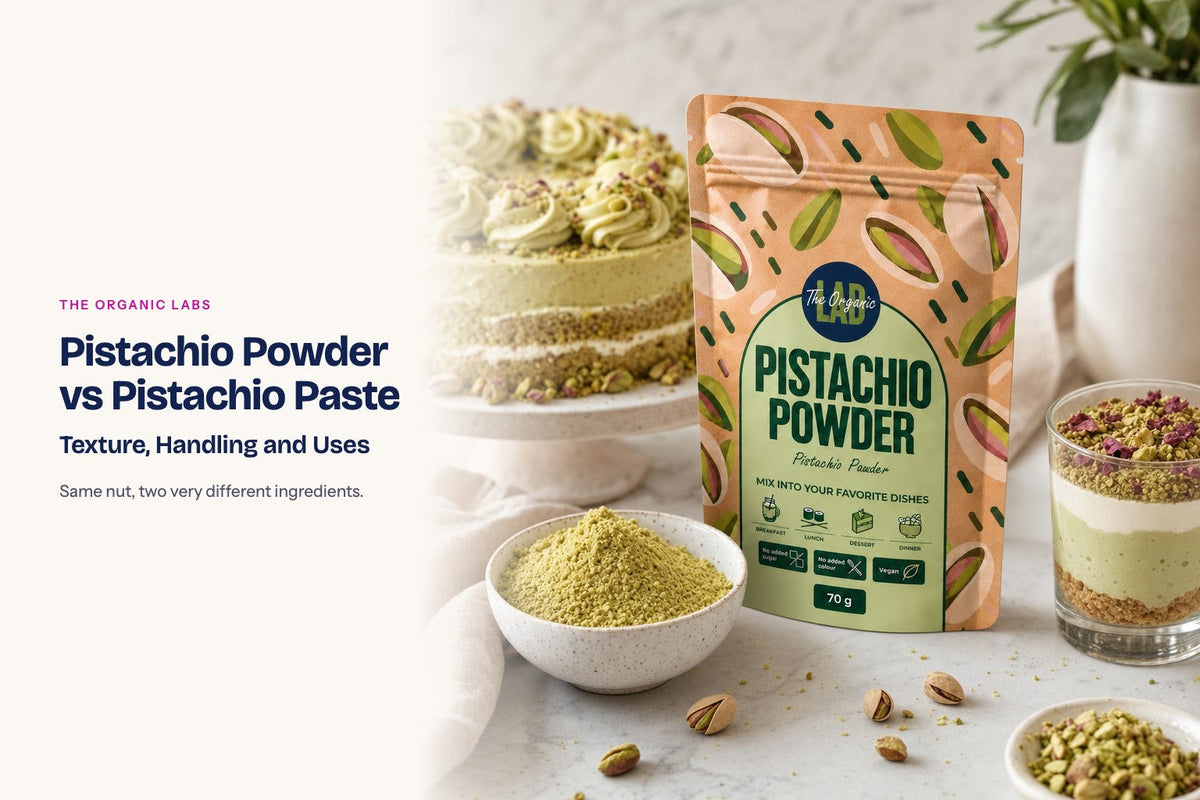
Pistachio powder and pistachio paste start from the same green kernels and carry the same flavour. In the kitchen, though, they behave like two different ingredients. One is a fine powder you weigh and whisk into flour or sugar; the other is a smooth, oily paste that flows into creams and fillings. Choosing the right one, or using both, makes a real difference to texture, colour and how easily a recipe comes together.
This comparison explains how each is made, how they differ in texture and handling, and where each works best in baking, chocolate and gelato.
How Each Is Made
Pistachio powder is made by milling shelled pistachio kernels into a fine, even powder. Ours is made from 100% pistachio nuts, finely milled, with no additives or fillers.
Pistachio paste is made by grinding the kernels for much longer, often after roasting, until the oil inside them is released and the nuts turn into a thick, smooth, spoonable mass, much like a nut butter. Pure pastes are 100% pistachio. Products sold as pistachio cream or pistachio spread are usually something else again: sweetened mixtures of pistachio with sugar, oil and often milk ingredients, made to be spread or used as a ready filling.
When you compare products, read the ingredient list first. A pure powder and a pure paste are both single ingredients, while a pistachio cream may contain a fairly small share of pistachio.
Texture and Mouthfeel
Paste is smooth and dense. It gives creams, ganache and gelato a full, round texture and a concentrated flavour, because the nut has already been broken down to release its oil. Powder is finer than anything chopped by hand but still has a little body. In a cake or biscuit it behaves much like ground almonds, giving a tender, slightly nutty crumb. In a cream or filling it adds a touch of texture rather than a perfectly silky finish.
For the smoothest possible filling, paste is the natural choice. For crumb, structure and a natural green tint in a batter or dough, powder is the easier one.
Handling and Measuring
- Weighing: powder is spooned and weighed like flour; paste has to be scooped and scraped, and some always stays on the spatula.
- Mixing: powder whisks evenly into flour, sugar and other dry ingredients; paste needs loosening into fat, cream or a little of the mix before it blends in smoothly.
- Separation: the oil in paste can rise to the top in storage, so it needs a thorough stir before use. Powder does not separate, although it can form soft clumps that a sieve breaks up.
- Moisture: powder absorbs moisture, so batters and doughs may need a little extra liquid; paste brings extra fat to a recipe instead.
- Decoration: powder can be dusted, sprinkled or used as a coating; paste cannot.
Colour
Both carry pistachio's natural green, but the shade depends on the nuts used and how they are processed. Roasting deepens the flavour and tends to push the colour towards olive and brown. In any form, natural pistachio green is softer than the bright green of coloured products, and heat dulls it further. Powder has one practical advantage here: dusted over a finished dessert, it puts the colour exactly where people see it.
Where Each Works Best in Baking
Powder is the easier choice for anything built on dry ingredients:
- cake batters and sponges, whisked in with the flour
- shortbread, sablés and biscuit doughs, where it keeps the texture short
- financiers, frangipane and macaron shells, in place of part of the ground almonds
- crumbles and streusel toppings
Paste comes into its own in smooth, rich elements such as pastry cream, mousseline, buttercream and the fillings for croissants, choux and doughnuts. Powder works in these too, giving colour and flavour with a little more texture, while paste gives the silkiest result. Many bakers use both: powder in the sponge or biscuit, paste in the cream. For more, see our guide to baking with pistachio powder.
Where Each Works Best in Chocolate
Chocolate is mostly fat, and even a little water can make it seize, so both forms suit it, since neither brings much moisture. Paste blends into melted chocolate for smooth, gianduja-style fillings in bars and bonbons. Powder gives fillings more body and a slightly textured bite, makes a quick coating for truffles, and can be scattered over bars as decoration. In both cases the pistachio's own oil softens the chocolate around it, which chocolate makers plan for. Our guide for chocolate and confectionery makers covers this in detail.
Where Each Works Best in Gelato
Traditional pistachio gelato is usually made with paste, which disperses into the base and gives a smooth, full texture. Powder works in gelato and ice cream bases too, as long as it is blended thoroughly, ideally mixed with the sugar first and given time to hydrate in the base before churning. It is also useful for the details: a dusting over each scoop, a pistachio crumb in a layered frozen dessert, or extra colour in a semifreddo. Both forms bring nut oil into the mix, which counts towards the fat in your recipe.
Storage and Shelf Life
Both forms contain the nut's natural oil, so both are sensitive to warmth, light and air, which can make them taste stale or rancid over time. Keep them sealed and cool. Our pistachio powder should be stored in a cool, dry place below 25 °C, away from direct sunlight, and has a shelf life of 2 years from the production date. Paste also needs stirring back together if its oil has separated, and a pistachio cream follows its own producer's storage advice.
Which Should You Choose?
- Choose powder for batters, doughs, crumbles, coatings and decoration, and whenever you want an ingredient that weighs and mixes like flour.
- Choose paste for the smoothest creams, ganache and gelato with a concentrated flavour.
- Use both when a dessert has several layers: paste for depth in the cream, powder for the crumb, the colour and the finish.
Whichever you use, remember that both are pistachio, a tree nut, and anything you serve or sell with them should say so.
Getting Pistachio Powder
Pistachio powder from The Organic Labs is currently supplied in bulk, from one 25 kg drum, for bakeries, chocolate makers, gelato shops and food producers. Businesses can request a quote or a sample on the Bulk Pistachio Powder 25kg page and compare it with paste in their own recipes. Home cooks will find methods and amounts in our guide on how to use pistachio powder.


