


Show someone a bright blue drink and ask what it tastes like, and most people will guess blueberry, bubblegum or something sweet and artificial. Butterfly pea surprises them. Its flavour is gentle, earthy and lightly floral, and in the quantities needed for colour most people barely notice it.
That mildness is exactly why cafés, bakeries and gelato makers use it. It gives colour while leaving the flavour of the drink or dessert to other ingredients. Mild is not the same as tasteless, though, and knowing what butterfly pea does taste like makes it easier to build good recipes around it.
The Flavour of Butterfly Pea
Tasted on its own, butterfly pea powder is earthy and slightly woody, with a light floral note in the background. Many people compare it to a mild green or herbal tea. It has no sweetness, no fruitiness and no real acidity. The dry powder smells much the same: faintly earthy, a little like dried herbs, and softer still once it is mixed into a drink.
In a strong infusion, the tea-like character becomes more noticeable and can leave a faint dryness on the finish. In a latte, a cake or a scoop of gelato, it largely disappears behind milk, sugar and fat.
Why the Colour Does Not Match the Taste
We are used to linking colour with flavour: red with strawberry, purple with blackcurrant, blue with blueberry. Butterfly pea breaks that rule. Its colour comes from pigments in the petals rather than from a fruit, and the pigment is strong enough that only a small amount of powder is needed. So the colour is intense while the flavour stays in the background.
This matters when writing a menu. Guests who expect a fruity blue drink may be disappointed unless the menu says what the drink actually tastes of, such as vanilla, coconut, lemon or honey.
Butterfly Pea in Lattes
In a blue latte, milk is the main flavour. Butterfly pea adds a soft, slightly earthy note and a hint of flowers, which most people describe as gentle rather than distinctive. Sweetener and syrup decide the character of the drink.
Vanilla and coconut are the most common partners and give a smooth, rounded latte. Honey brings a warmer sweetness. A small amount of lavender or rose syrup leans into the floral side, but both are strong and can easily take over. The choice of milk matters too: oat milk adds a cereal sweetness, coconut drink a tropical note and dairy milk a creamy, neutral base.
Iced versions taste milder again, because cold mutes flavour and melting ice dilutes the drink.
Butterfly Pea in Lemonades, Teas and Cocktails
In citrus drinks, lemon or lime dominates and butterfly pea contributes mostly colour, plus the change from blue to purple. In an iced butterfly pea tea, the earthy, tea-like note is more noticeable and works well with lemongrass, ginger, mint or a little honey.
In cocktails and mocktails, the flower sits comfortably next to juniper and other botanicals, elderflower, cucumber and tonic water. Tonic is acidic too, so it will shift the colour towards violet.
Butterfly Pea in Baking
In cakes, sponges, cookies and breads, the taste of butterfly pea is mostly hidden by butter, sugar, eggs and vanilla. At higher dosages a delicate sponge can pick up a faint earthy or vegetal note, which is one reason to find the lowest amount that gives the colour you want.
Good partners in baking include vanilla, coconut, white chocolate, almond and lemon. Lemon comes with a warning: its acidity turns the colour violet or pink, which can be a feature in a filling but a surprise in a sponge. Our guide on how to use butterfly pea powder explains how to manage that.
Butterfly Pea in Desserts and Ice Cream
Cold, creamy desserts carry butterfly pea well. Fat rounds off its slight earthiness, and low serving temperatures mute it further, so a blue gelato or panna cotta tastes mainly of its milk, cream, coconut or vanilla. In a lemon sorbet, butterfly pea turns the colour pink to purple while the lemon carries the flavour.
Flavour Pairings That Work
- Vanilla: the classic partner for blue lattes, cakes and gelato.
- Coconut: in lattes, smoothies, gelato and rice-based desserts.
- Lemon and lime: for colour-changing drinks, fillings and sorbets.
- Honey: in teas and lattes.
- Lemongrass, ginger and mint: for iced teas and mocktails.
- Lavender, rose and elderflower: in small amounts, to underline the floral side.
- White chocolate and almond: in baking and confectionery.
- Mango and pineapple: in smoothies, keeping in mind that acidic fruit shifts the colour.
Coffee and dark chocolate are less a question of flavour than of colour: their brown hides the blue. That is why a blue latte is usually made without espresso.
Butterfly Pea and Blue Spirulina Compared
Both are used mainly for colour and both are mild. Butterfly pea leans earthy and slightly floral, while blue spirulina is largely neutral. The bigger differences between the two are in shade and in how they react to acid and heat, which we cover in butterfly pea vs blue spirulina.
How to Taste-Test Butterfly Pea
For a business adding butterfly pea to the menu, a short tasting session is worth the time. Prepare the drink or dessert with your own milk, sweetener and base at two or three dosages and taste them side by side. Ask staff who have not seen the recipe to describe the flavour. If the flower is noticeable, reduce the dosage or adjust the flavouring; if the colour is too pale, increase the dosage step by step and taste again. Taste hot and iced versions separately, because temperature changes how much of the flower comes through.
Try Butterfly Pea Powder
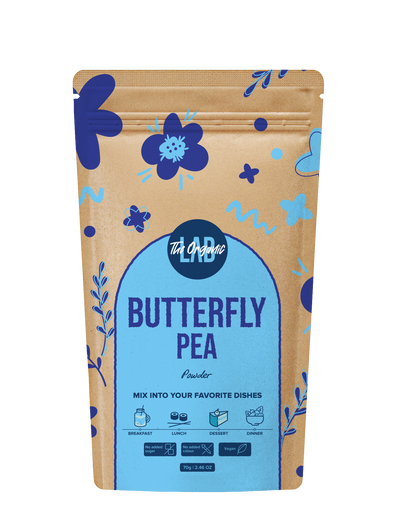
To taste it for yourself, start with our Butterfly Pea Powder 70g. Cafés, bakeries and producers who need regular volumes can request a quote and a sample for Bulk Butterfly Pea Powder 25kg.


