

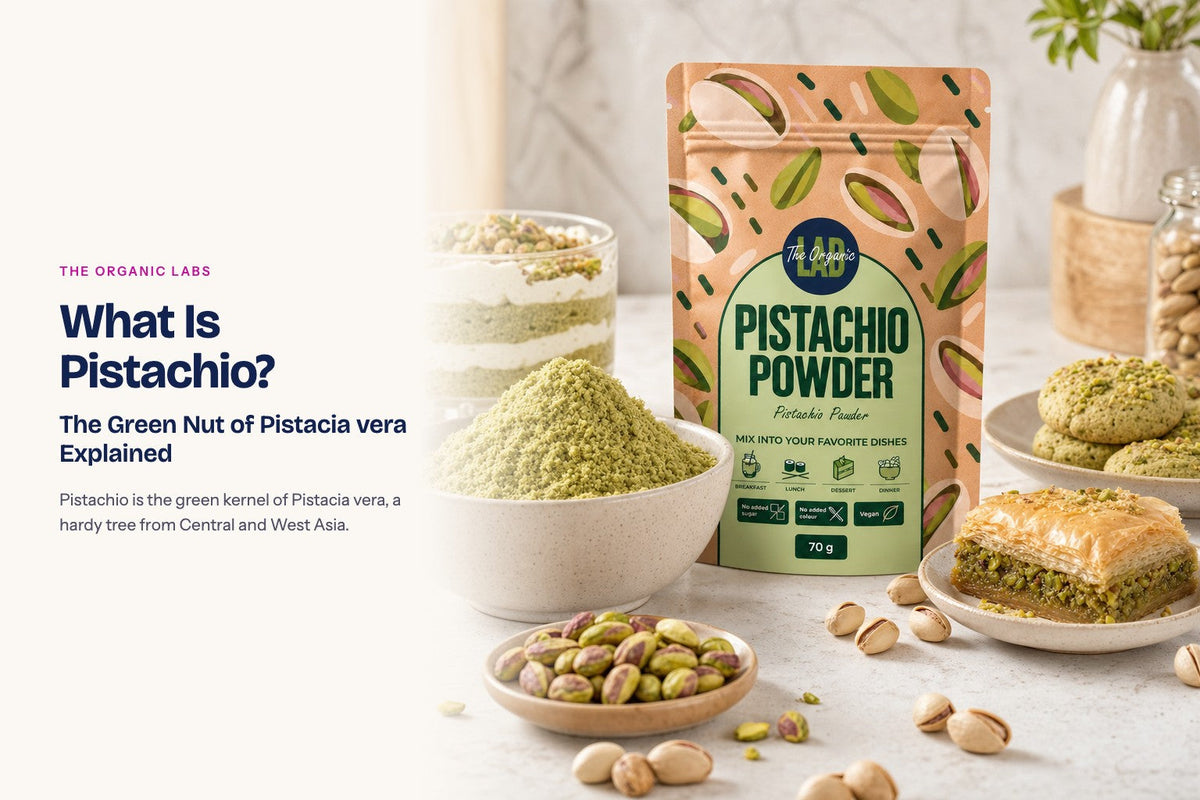
Few nuts are recognised by colour alone, but pistachio is one of them. A soft green on a pastry, a scoop of gelato or a chocolate bar tells people what flavour to expect before they taste it. Behind that colour is a hardy tree from dry country, a nut with an unusual way of opening, and a long place in the sweets of the Middle East, the Mediterranean and South Asia.
This guide explains what pistachio is, how it grows, what gives it its colour, the forms it is sold in, and what pistachio powder is and how cooks use it.
The Pistachio Tree: Pistacia vera
The pistachio we eat comes from Pistacia vera, a small deciduous tree native to Central and West Asia. It belongs to the Anacardiaceae, the same plant family as cashew and mango. Several other Pistacia species grow wild around the Mediterranean and further east, some of them valued for their resin, but Pistacia vera is the one grown for its nuts.
The tree is built for harsh conditions. It copes with poor soil and dry heat, and it needs a cold winter to rest before it flowers in spring. Pistachio trees are either male or female: only the female trees bear nuts, and they rely on the wind to carry pollen from male trees nearby. Young trees take several years to give a real crop, and many orchards alternate between heavier and lighter harvests from one year to the next.
Hull, Shell and Kernel
Botanically, the pistachio fruit is a drupe, like a cherry or an olive, although the part we eat is the seed rather than the flesh. The fruits grow in heavy clusters, and each one has three layers:
- the hull, a soft outer skin that turns from green to a rosy or yellowish colour as the fruit ripens, and is removed after harvest
- the shell, hard and pale, which splits open along its seam as the kernel grows
- the kernel, the green seed inside, wrapped in a thin purple to reddish skin
That naturally split shell is why pistachios are so often sold in the shell: they open by hand, without a nutcracker. For pastry and food production, the kernels are shelled first and then used whole, chopped, ground, or turned into paste and powder.
Where the Green Colour Comes From
Most nuts are cream or pale brown inside. Pistachio kernels range from yellowish to deep green, often with a purple blush just under the skin. The colour comes from the nut's own natural pigments, and it varies with the variety, the growing conditions and when the nuts are picked. That is why pistachio products, whether kernels, paste or powder, can differ in shade from one source to another.
That colour is a large part of pistachio's appeal in the kitchen. It gives creams, fillings, gelato and decorations a natural green without any added colouring. Heat softens it, so the clearest green tends to appear in unbaked or lightly cooked uses, which is worth knowing before you plan a recipe around it.
How Pistachio Tastes
Pistachio tastes nutty, rich and gently sweet, with a buttery roundness and a faint green, almost resinous note that sets it apart from almond or hazelnut. It is milder than many people expect, which is why it pairs so well with fruit, cream and white chocolate, and why it can be lost next to strong flavours. Our guide to what pistachio tastes like looks at how that flavour changes in baking, chocolate and gelato.
The Forms Pistachio Is Sold In
- In the shell, usually roasted and salted, for snacking
- Shelled kernels, whole, for decoration, nougat, biscotti and savoury dishes
- Chopped or slivered kernels, for toppings, baklava and Persian and Indian sweets
- Paste, kernels ground until smooth, for creams, fillings and gelato
- Pistachio cream or spread, a sweetened product with sugar and other ingredients
- Powder, kernels finely milled, for batters, doughs, creams, chocolate and decoration
What Is Pistachio Powder?
Pistachio powder is pistachio kernels milled into a fine powder. Ours is pistachio powder (Pistacia vera) from Turkey, finely milled from pistachio nuts for bakery, chocolate and dessert production. It is made from 100% pistachio nuts, with no additives or fillers, and it brings a natural green colour and a nutty, rich pistachio flavour.
Pistachio kernels contain natural oil, and milling keeps it in the powder, so the powder can form soft clumps if it is pressed or kept somewhere warm. A quick sift before use breaks them up. The powder sits between chopped nuts and paste: finer and more even than anything you can chop by hand, but easy to weigh, sprinkle and whisk into flour. Our comparison of pistachio powder vs pistachio paste explains when each form works best.
How Pistachio Is Used in the Kitchen
Pistachio has a place in the sweets of many cuisines:
- baklava and other layered pastries of Turkey, the Middle East and the Balkans
- Persian nougat and pastries
- kulfi, barfi and other Indian sweets
- Sicilian cannoli, cakes and pistachio gelato
- French macarons, financiers and pastry creams
- pralines, nougat and filled chocolate across Europe
Pistachio powder suits many of these. It goes into cake batters and biscuit doughs, creams and fillings, chocolate and spreads, ice cream and frozen desserts, and it makes a simple green decoration dusted over a finished dessert. It also has savoury uses, such as a crust for fish or lamb, though most cooks reach for it in pastry. Our guide to using pistachio powder gives methods and amounts.
A Note on Allergens and Storage
Pistachio is a tree nut. Our specification states it plainly: contains pistachio (tree nut). If you bake for others, tell them what is in the recipe, and keep pistachio dishes apart from food for guests who avoid nuts.
Like other nuts, pistachio can turn stale or rancid if it is kept warm, in the light or open to the air. Store the powder sealed in a cool, dry place below 25 °C, away from direct sunlight. Kept that way, ours has a shelf life of 2 years from the production date.
Pistachio Powder From The Organic Labs
Pistachio powder from The Organic Labs is currently supplied in bulk, from one 25 kg drum, to bakeries, pastry kitchens, chocolate makers, gelato shops and food producers across Europe. Businesses can request a quote, documents or a sample on the Bulk Pistachio Powder 25kg page. Home cooks will find more ideas in our other pistachio guides.


