


Ube Powder for Food Manufacturers in Europe
As Ube becomes increasingly visible in European food and beverage products, manufacturers are exploring how purple yam powder can be incorporated into new product development and commercial production.
Ube, botanically known as Dioscorea alata, is a purple yam particularly associated with Filipino cuisine. Its naturally distinctive colour and mild flavour have helped introduce Ube to a much wider international audience.
For food manufacturers, however, sourcing Ube is about considerably more than creating a purple product.
Ingredient identity, specifications, batch documentation, traceability, packaging, available volumes and consistency of supply all become important when moving from initial product development to commercial production.
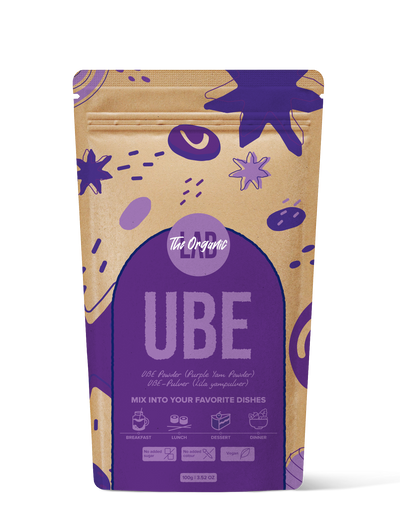
The Organic Labs supplies Ube Purple Yam Powder from Sweden to professional customers and food businesses across Europe.
Ube Powder as a Food Ingredient
Ube powder is produced by processing purple yam into a dried, milled format.
For manufacturers outside regions where fresh Ube is cultivated, powder provides a practical format for storage, transportation and incorporation into food formulations.
It can be evaluated for a wide range of product categories, including bakery products, desserts, beverages, frozen products, confectionery and foodservice preparations.
The suitability and required quantity will depend on the individual formulation and production process.
Ube Powder for Product Development
Many commercial Ube products begin with relatively small development trials.
During this stage, manufacturers can evaluate how Ube powder interacts with the other ingredients in their formulation and determine the appropriate concentration for the desired result.
Factors such as flavour, colour, texture, moisture, temperature and pH can all influence the finished product.
For this reason, manufacturers should test Ube powder under their actual production conditions before establishing a final commercial formulation.
Ube Powder for Bakery Manufacturing
Ube has become particularly popular in bakery and pastry applications.
Potential commercial products include cakes, cookies, muffins, buns, pastries, cheesecakes, fillings and dessert preparations.
The amount of Ube required will vary depending on the formulation and the desired flavour and appearance.
Manufacturers should also consider the effect of baking temperature and other ingredients on the final colour of the product.
Because Ube is a natural agricultural ingredient, its behaviour should not be compared directly with that of an artificial food colouring.
Ube Powder for Beverage Manufacturing
The growing popularity of Ube lattes has created interest in Ube beyond cafés and into larger-scale beverage development.
Ube powder can be evaluated for powdered beverage preparations, café mixes and other speciality beverage concepts.
Commercial beverage manufacturers should test factors such as dispersion, sedimentation, flavour, colour and compatibility with other ingredients within their own formulations.
The final characteristics of an Ube beverage can vary considerably depending on the recipe.
Ube Powder for Ice Cream and Frozen Desserts
Ube has a long association with desserts and is increasingly being explored for ice cream, gelato and other frozen applications in Europe.
Its purple appearance can provide a distinctive visual identity, while its flavour can complement ingredients such as coconut, vanilla and dairy or plant-based bases.
For industrial production, the ingredient should be tested within the manufacturer's actual formulation and processing conditions.
Ube Powder for Confectionery and Desserts
Ube can also be explored in chocolate products, fillings, dessert bases and confectionery concepts.
These applications can differ substantially in fat content, sugar concentration, moisture and processing temperature.
Consequently, there is no universal Ube dosage suitable for every manufactured food.
Commercial trials remain essential when developing a new Ube product.
Botanical Identity: Dioscorea alata
Ingredient identity is particularly important when sourcing Ube commercially.
Genuine Ube is the purple yam botanically identified as Dioscorea alata.
Ube should not be confused with purple sweet potato simply because both ingredients can produce purple powders.
Purple sweet potato belongs to the species Ipomoea batatas and is a separate ingredient.
For professional buyers, checking the botanical identity is therefore an important part of evaluating an Ube powder supplier.
Natural Ube Powder Colour
Colour is one of the principal reasons Ube has attracted the attention of product developers.
However, natural Ube powder should not be treated as though it were a standardised artificial colour.
The appearance of agricultural ingredients can vary according to the raw material and processing conditions.
The final colour within a manufactured product can also be affected by the other ingredients in the formulation and the production process itself.
Manufacturers developing products where colour is particularly important should therefore carry out trials using their intended recipe and processing method.
Documentation for Food Manufacturers
Professional food manufacturers frequently require technical information before approving a new ingredient.
Depending on the ingredient and batch, this can include product specifications, Certificates of Analysis and other relevant product documentation.
Batch identification and traceability are also important components of professional ingredient supply.
Documentation requirements can vary between manufacturers, countries and applications, so buyers should communicate any specific requirements during the sourcing process.
Bulk Ube Powder for Manufacturing
Once a product moves beyond development trials, ingredient volume becomes increasingly important.
A manufacturer producing hundreds or thousands of finished units requires a very different supply structure from a consumer purchasing Ube powder for home use.
The Organic Labs works with professional quantities including 25 kg, 50 kg and 100 kg requirements, as well as approximately 500 kg pallet quantities and larger commercial projects.
This allows manufacturers to move from product development toward larger production requirements as their Ube products scale.
Sourcing Ube Powder in Europe
European manufacturers sourcing specialist ingredients directly from overseas may need to manage international transportation, customs procedures, larger minimum quantities and longer supply chains.
Working with a European Ube powder supplier provides another procurement route.
The Organic Labs is based in Sweden and supplies professional customers across the European Union.
This is particularly relevant for manufacturers that require commercial quantities of Ube while purchasing through a European supplier.
Choosing an Ube Powder Supplier for Manufacturing
Price per kilogram is only one consideration when selecting a supplier.
Food manufacturers should also consider the botanical identity of the ingredient, specifications, documentation, traceability, available packaging, commercial volumes and supply continuity.
For recurring manufacturing projects, the ability to obtain appropriate quantities as production grows can become particularly important.
Ube is no longer limited to small consumer or speciality-market applications. As European demand develops, it is increasingly becoming an ingredient considered for professional food and beverage development.
For manufacturers, selecting the appropriate Ube Purple Yam Powder and establishing a reliable European supply chain are important steps in taking an Ube concept from initial development to commercial production.


