

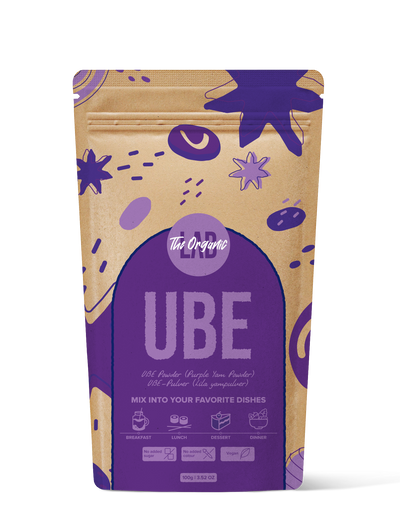

Ube gives a café a purple drink with a flavour of its own. The powder is purple yam (Dioscorea alata), dried and finely milled. In milk it ranges from pale lavender to violet, and the taste is mild, gently sweet and slightly nutty.
This guide is for cafés, coffee shops and brunch places that want ube on the menu. It covers the drinks, the amounts, what to pair with ube, and how to set up the bar so the last latte of a busy Saturday looks like the first one.
Where Ube Fits on a Café Menu
Ube sits between two drinks most menus already have. Like matcha, it is a powder whisked to a paste before the milk goes in, so staff need no new method. Like hot chocolate, it turns soft and dessert-like with milk and a little sugar, which suits customers who find matcha too bitter.
- Single ingredient: the powder is 100% ube with no additives or fillers, so you decide the sweetness and the flavouring.
- Hot and iced: the same dose and the same paste cover both.
- Vegan: it works with plant-based milk as well as dairy.
- Dry storage: it keeps in a cool, dry place below 25 °C.
The Hot Ube Latte
For a 300 ml cup, start with 3–5 g of ube powder.
- Weigh the powder into the cup or a small jug.
- Add a splash of warm milk or water and whisk until no lumps remain.
- Stir in sugar or syrup while the paste is still warm, so it dissolves.
- Top up with steamed milk and finish with a light dusting of powder on the foam.
Do not skip the paste. The powder is the yam itself, so it disperses rather than dissolving completely, and dry powder tipped into a full jug of milk stays in specks. Sweetener brings out the dessert side of ube, so settle the amount in a tasting and write it on the recipe card.
Iced Ube Drinks
Use the same 3–5 g for a 300 ml iced drink, and make the paste warm even though the drink is cold. Fill the glass with ice, spoon in the paste, then pour the milk slowly for a layered look, or shake everything together for an even lilac.
- Iced ube latte: ube paste, ice and cold milk, with vanilla syrup if you like it sweeter.
- Iced ube coconut latte: the same drink with coconut milk, ube's best-known partner.
- Ube cold foam: ube whisked into sweetened cold foam and spooned over iced coffee or cold brew.
- Ube and coconut water: chilled coconut water over ice, topped with a frothed layer of ube, coconut milk and coconut cream.
The powder settles in a drink that is left standing, so serve cold drinks straight away with a straw.
Ube With Coffee or Matcha
Coffee is a good contrast to ube, as long as it does not take over. Espresso is the stronger flavour and browns the purple when it is stirred in. Pour a single shot over a finished iced ube latte, serve it unstirred in a clear glass and let the customer mix it. A dirty ube latte is sold on its layers.
Ube and matcha give a two-colour glass from two powders you may already have on the bar: ube milk at the bottom, ice in the middle, whisked matcha on top. Keep the ube layer sweeter than the matcha layer, because sugar makes it heavier and helps the colours stay apart.
Bubble Tea, Smoothies and Shakes
For ube milk tea, blend 3–5 g per serving into the milk base before adding ice, then pour over tapioca pearls. Choose a light tea or leave the tea out, because ube is mild. Our article on ube powder for bubble tea and drinks explains how the powder differs from syrups, ready-made mixes and taro.
- Ube smoothie: ube with banana and coconut milk.
- Ube milkshake: vanilla ice cream, milk and ube.
- Ube frappé: ube paste, milk, syrup and ice, blended until smooth.
- Ube white hot chocolate: ube paste stirred into white hot chocolate.
A blender spreads the powder evenly, so blended drinks are the easiest place for new staff to start.
Flavours That Suit Ube
The usual partners are coconut, vanilla, milk and cream, white chocolate, condensed milk and coffee. What they share is that they are creamy or sweet. Keep stronger flavours in the background, since ube is easily covered.
Guests who have never had it often expect vanilla, because the two are so often combined in desserts. The vanilla comes from the recipe; ube on its own is subtly sweet, a little earthy and a little nutty. Staff are also asked if it is purple sweet potato or taro. It is neither: ube is a yam. Our article on what ube tastes like is short enough to use for training.
Milk, Colour and Consistency
Real ube is not neon purple. Milk and cream make it lighter, and whole, oat, coconut and soy milk each change the shade, the flavour and the texture. Test the drink with every milk you offer and write one recipe per milk. Acidity affects the colour too, so try anything with citrus or sharp fruit before it goes on the menu.
- Weigh the powder in grams instead of scooping it.
- Photograph the correct drink with each milk and keep the photos at the bar.
- Make one latte from each new bag and compare it with the photo, because the purple of a natural ingredient varies a little.
- Store the bag closed, in a cool, dry place below 25 °C, away from direct light and from steam, and use a dry scoop. Shelf life is 2 years from the production date.
Preparing Ube for Fast Service
Whisking to order works on a quiet morning. For a busy bar, choose one of two set-ups.
Pre-weighed portions
Weigh single doses into small lidded pots before opening, with the sugar already mixed in if every drink gets the same amount. The barista tips one pot into the jug, adds a splash of warm milk and whisks. The powder stays dry until it is used.
Ube base
- Multiply your dose by the number of drinks. At 4 g a drink, 20 drinks need 80 g of powder.
- Whisk or blend the powder into warm water, with the sugar or syrup if your recipe is sweetened, until it is smooth and pours easily.
- Weigh the finished base and divide it by the number of drinks. That is the amount to pour into each one.
- Cool it, cover it, label it with the date and time and keep it chilled.
- Shake or stir before every pour.
How long a base can be kept depends on your recipe and your own food safety procedures. Begin with a small batch and note how much is left at closing. Other colours can be prepared in much the same way: our article on colourful lattes for coffee shops has one drink per powder, and you can mix 3, 5 or 10 bags to stock more than one.
Menu Ideas
- Ube latte, hot or iced
- Iced ube coconut latte
- Dirty ube latte with a layer of espresso
- Ube and matcha layered latte
- Ube milk tea with tapioca pearls
- Ube and banana smoothie
- Ube white hot chocolate
- Ube pancakes or waffles with coconut cream for brunch
- Ube and white chocolate cookies, ube cheesecake or coconut-frosted ube cupcakes for the counter
A drink and a bake in the same purple make an easy display. Our guide to baking with ube powder covers the counter side, and the bulk page linked below has a dosage table for cakes and fillings.
Ordering Ube for Your Café
If ube is new to you, start with a sample of one powder or five and test it with your own milk. For daily service, our café page has 1 kg bags for cafés in sets of 3, 5 or 10. At 3–5 g per drink, 1 kg makes roughly 200 to 330 lattes.
You can also order a single bag of Ube Purple Yam Powder – 1kg. Café groups and production kitchens can request a quote for bulk ube powder in 25 kg drums, supplied with a certificate of analysis for every batch.


